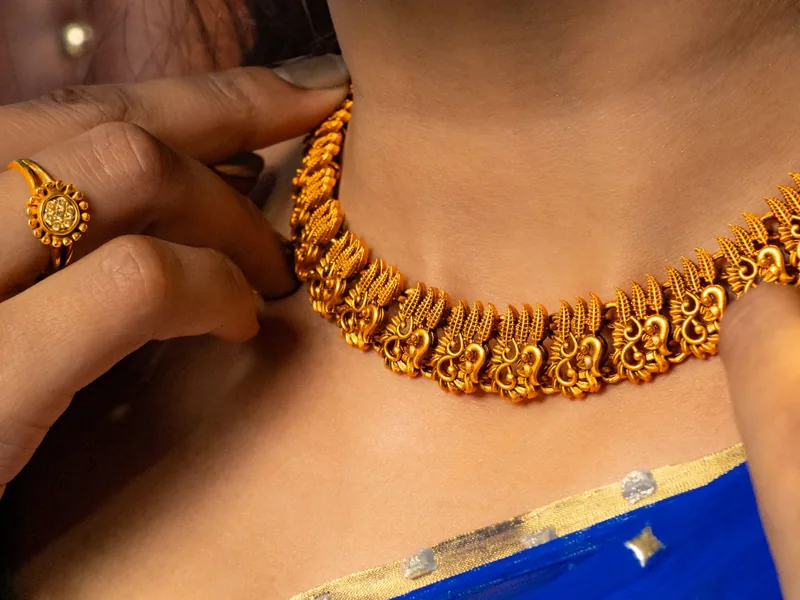
A daily-wear mangalsutra is usually a short chain of about 4 to 10 grams, and most buyers choose 22K (916) gold for the traditional look, or 18K (750) when the pendant carries diamonds or the chain needs to be tougher. At the example rate used on this page (₹13,500 per gram for 22K, an example and not today's rate), that puts the gold alone at roughly ₹54,000 to ₹1,35,000 before making charges and 3 percent GST.
Decide the weight first and the design second. That one habit does more for your budget than any discount. Every rupee figure below is a labelled example so you can follow the sums, so swap in the current rate from your jeweller or a published source before you shop.
Which mangalsutra designs belong to which region?
The mangalsutra is not one design. It is a family of wedding necklaces, and what a bride wears depends on her community, her family and where she lives. The table sums up the best-known forms as jewellers and cultural guides describe them. Families differ, so read it as a map and not a rulebook.
| Community or region | Typical design | Worth knowing |
|---|---|---|
| Maharashtrian | Black and gold beads on a double strand, with two small gold cups called vatis | The two vatis are read as Shiva and Shakti. Some guides describe a plain black-bead style and a style with gold beads set between the black ones. |
| Gujarati | Black beads with an intricate gold pendant | Newer versions often use a shorter chain with a gold or diamond pendant. |
| North Indian (many Hindu families) | Gold chain with black beads and a gold pendant | Length and weight vary a lot by family. Many working women now prefer a short chain so the pendant stays visible. |
| Tamil | The thali or thirumangalyam, a gold pendant tied first on a yellow thread | Many families later move it to a gold or black-bead chain. Pendant motifs vary by community. |
| Telugu | Pustelu or bottu: a disc, or a pair of discs, on a gold or black-and-gold bead chain | In many Telugu communities each side of the wedding party gives one disc. |
| Kannada | Maangalya sutra with two round gold plates, black beads and sometimes coral or pearls | Coorg (Kodava) brides have their own pieces, the karthamani and the pathak. |
| Kerala | The ela thali, a leaf-shaped gold pendant, for many Hindu families; the minnu for Syrian Christian weddings | The minnu is a small pendant of gold beads set in a cross, often described as a small medallion or leaf shape, varying by community. |
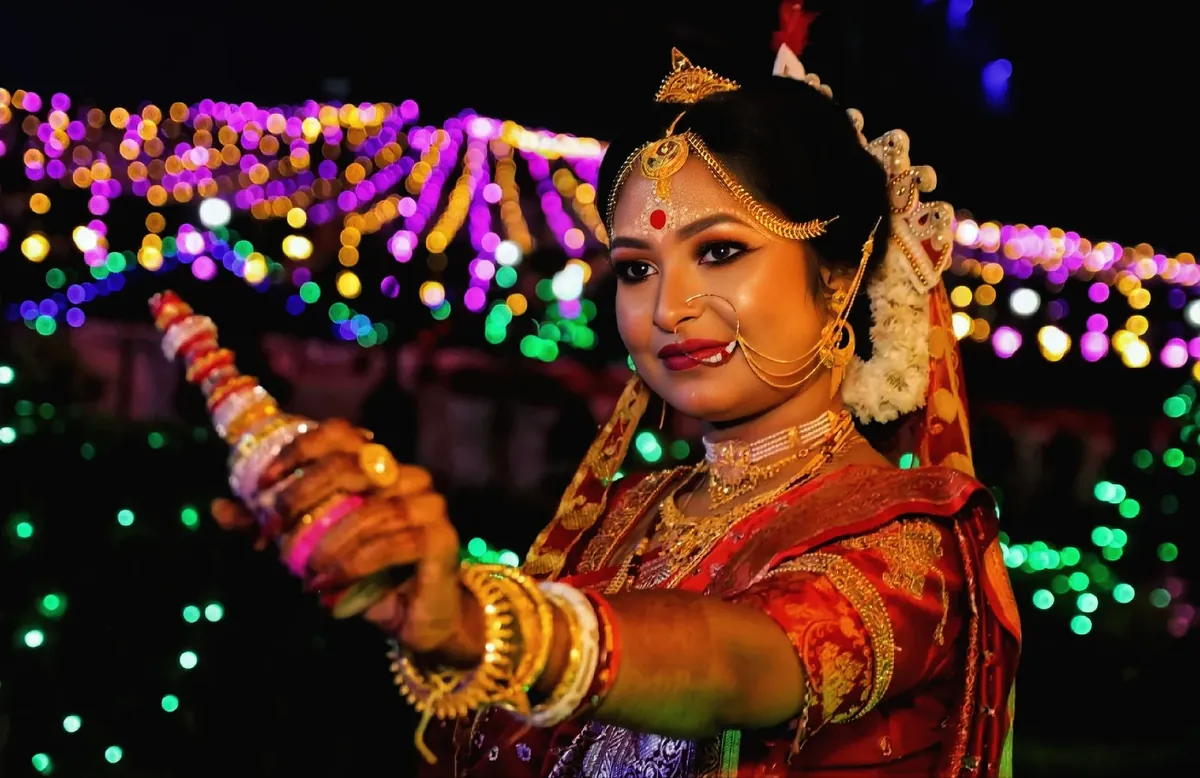
Two clarifications save confusion in the shop. A kasu mala, the South Indian necklace of coin motifs that often shows Lakshmi, is a separate bridal necklace and not a thali. And Bengal is not a gap in the table so much as a different tradition: married Bengali Hindu women commonly wear shakha (white conch-shell) and pola (red coral) bangles, an iron bangle called the loha, and sindoor.
Please do not file a loha or a shakha-pola bangle under mangalsutra. They are different pieces with their own customs, and each family decides what, if anything, to add.
Short or long: which mangalsutra length suits you?
Retail guides group chains into three lengths. Short is about 16 to 18 inches and sits at or just below the collarbone. Medium is about 20 to 24 inches. Long is about 28 to 36 inches, a style often worn over the saree pallu in South Indian and Gujarati families. Try a chain on before you commit.
Our stance: for office and daily wear, choose a short chain with a small pendant, and keep the long one for sarees and occasions. A long chain with a heavy pendant pulls on the neck, catches on seatbelts and laptop bags, and ends up in the cupboard.
How much should a mangalsutra weigh, and what does it cost?
Retail guides usually describe weight in bands: about 4 to 10 grams for lightweight daily wear, 11 to 20 grams for a medium traditional piece, and 21 to 40 grams for a bridal or heavy piece. These are indicative bands from jewellers' own guides, not standards, so use them to sense-check a quote.
The table turns four weights into example totals. It uses 22K at an example ₹13,500 per gram, an example making charge of 10 percent, and 3 percent GST on the total including making charges.
| Weight (22K, EXAMPLE) | Gold value | Making at 10 percent (EXAMPLE) | GST at 3 percent | Example total |
|---|---|---|---|---|
| 6 g, slim daily chain | ₹81,000 | ₹8,100 | ₹2,673 | ₹91,773 |
| 10 g, sturdier daily chain | ₹1,35,000 | ₹13,500 | ₹4,455 | ₹1,52,955 |
| 16 g, medium traditional | ₹2,16,000 | ₹21,600 | ₹7,128 | ₹2,44,728 |
| 24 g, bridal | ₹3,24,000 | ₹32,400 | ₹10,692 | ₹3,67,092 |
A handy rule from the example: after making charges and GST, each ₹1 lakh buys about 6.5 grams of 22K gold. Hand-worked pieces carry higher making charges than machine-made ones, so your own figure may be higher. Here is how that plays out by budget.
- Up to about ₹1 lakh: a short chain of roughly 5 to 6.5 grams with a simple pendant. One retail guide cautions that chains below about 2.5 grams are usually too fine to stand up to daily friction, so avoid going thinner than that for something you will wear every day.
- About ₹1 lakh to ₹2.5 lakh: 10 to 16 grams. This is the range where a vati, thali or gold-bead chain starts to feel like a proper traditional piece.
- Above ₹2.5 lakh: 20 grams and up, which is where bridal and heirloom pieces sit. If this is for a wedding, our bridal jewellery guide helps you decide what to buy, rent or skip.
18K or 22K: which is better for a mangalsutra?
Choose 22K for plain gold designs and 18K for diamond pendants and very light pieces. 22K gold is 91.6 percent pure and carries the mark 22K916. 18K is 75 percent pure and carries 18K750. The extra alloy in 18K makes it harder, which is why jewellers recommend it to hold diamonds in prongs. 22K is softer, which suits plain gold and bezel-set stones.
Guides also note that the same design is usually lighter in 18K, and that 18K is seen as less traditional for a thali or vati. The table compares the same 8 gram piece at example rates: ₹13,500 per gram for 22K, and ₹11,050 per gram for 18K, which is roughly 750 divided by 916 of the 22K figure. Both are examples, not today's rates.
| EXAMPLE, 8 g piece | 22K (916) | 18K (750) |
|---|---|---|
| Example rate per gram | ₹13,500 | ₹11,050 |
| Gold value | ₹1,08,000 | ₹88,400 |
| Making at 10 percent (EXAMPLE) | ₹10,800 | ₹8,840 |
| Total before GST | ₹1,18,800 | ₹97,240 |
| GST at 3 percent | ₹3,564 | ₹2,917 |
| Example total | ₹1,22,364 | ₹1,00,157 |
The 18K piece costs less, but you are buying less gold, not a cheaper version of the same thing. When you sell, a jeweller values the pure gold content at that day's rate, and making charges and GST are not returned. Our making charges guide explains why plain pieces make better stores of value than heavily worked ones.
Our verdict: for a plain thali, vati or gold-bead chain, buy 22K. For a daily-wear chain with a diamond pendant, 18K is the practical choice.
How is the price of a mangalsutra built up?
Every quote is the same five or six lines in a different order. Ask for them one by one.
- Net gold weight times the day's rate for the carat you are buying.
- Making charges, quoted as a percentage, a rupee amount per gram or a flat fee for the design.
- Stones and diamonds, priced separately from the gold.
- Black beads, thread and other non-gold parts. These are not gold, so the gold rate should not be charged on their weight.
- GST at 3 percent on the whole value of the finished jewellery, making charges included.
- The hallmarking fee.BIS raised the gold hallmarking fee to ₹75 per article plus taxes in September 2026 (some BIS pages still show the older ₹45). The jeweller pays it, and some show it as a separate line while others fold it into the price, so ask for it as its own line and check the current fee.
The bill should show gross weight, the weight of beads and stones, and the net gold weight. If it only shows one weight, ask which one it is. Our gold price calculation guide walks through the arithmetic with a worked example.
Should you add diamonds to a mangalsutra?
Diamond pendants are popular in short, modern mangalsutras, usually set in 18K for strength. The diamond is priced separately from the gold, and unlike gold it does not come back to you at the gold rate on resale.
A laboratory-grown diamond usually costs less than a natural one of the same size, but resale value and certification differ. Before you pay for either, ask for the stone's grading certificate, ask for the stone price as its own line on the bill, and ask in writing what the jeweller will pay back if you return it. Our diamond buying comparison covers the trade-offs in detail.
How do you check the hallmark and HUID on a mangalsutra?
Look for three marks: the BIS logo, the purity mark (22K916 or 18K750), and a six-character alphanumeric HUID. Retail guides say they sit on the back of the pendant or on the clasp. They are tiny, so ask the jeweller for a magnifier.
Then type the HUID into the free BIS Care app under Verify HUID, which BIS provides for exactly this purpose. Only the gold part carries a hallmark. The black beads and thread do not.
One honest caveat: mandatory hallmarking applies in notified districts, not everywhere. It started with 380 districts from 2 March 2026 and later orders have extended it (a Third Amendment Order of 3 August 2026 took coverage to 392 districts, according to Business Standard), so check the current BIS list for your district.
There are exemptions too, including pieces under 2 grams, jewellers with annual turnover up to ₹40 lakh, and Kundan, Polki and Jadau work. Our HUID and hallmark checklist has the step-by-step version.
How do you care for and insure a mangalsutra?
A mangalsutra is worn daily, so it meets more perfume, sweat and friction than most jewellery. These habits help.
- Put it on after lotions, perfumes and hairspray, not before.
- Take it off for swimming, because chlorine and harsh cleaners are best avoided.
- Clean it by soaking in lukewarm water with two or three drops of mild dishwashing liquid for about ten minutes, then brush gently with an ultra-soft toothbrush, rinse, pat dry and air-dry fully.
- Check the clasp, links and bead string now and then, and restring when the thread frays.
- Store it flat with the clasp fastened. Check jewellery pouches on Amazon
For insurance, keep three things together: the invoice, a photo of the hallmark and HUID, and a note of the net weight. Home insurance policies often cover jewellery only up to the value you declare, and insurers commonly ask for a valuation certificate from a reputable jeweller.
Do not assume a bank locker covers you either: RBI's locker rules state that banks have no record of the contents and do not insure them, and a bank's liability in listed cases such as fire or theft is capped at 100 times the locker's annual rent.
Frequently asked questions
Which is better for a mangalsutra, 18K or 22K?
22K suits plain gold designs and is the traditional choice. 18K is harder, so jewellers prefer it for diamond pendants and very light daily-wear pieces. The two are priced per gram at different rates, so compare the total price and the net gold weight, not only the headline number.
How many grams should a daily-wear mangalsutra be?
Retail guides commonly describe about 4 to 10 grams for lightweight daily wear and about 11 to 20 grams for a medium traditional piece. One guide advises against chains thinner than about 2.5 grams for daily use because the links are too fine.
Is a mangalsutra hallmarked?
The gold part should carry the BIS logo, a purity mark and a HUID if it was sold in a notified district and no exemption applies. Pieces under 2 grams and Kundan, Polki and Jadau work are exempt. Black beads and thread are not hallmarked.
Do I get the making charges back if I sell my mangalsutra?
Generally no. Jewellers value old gold on its pure gold content at that day's rate, and making charges and GST are not credited back. Read the buyback terms before you buy.
Do all Indian brides wear a mangalsutra?
No. Customs differ by community and family. Many Bengali Hindu women wear shakha, pola and loha bangles and sindoor instead. If you are buying for someone else's wedding, ask the family what is expected.
Your next step: pick a weight band, a carat and a pendant style, then ask two jewellers for quotes that list net gold weight, rate, making charge, stones and GST as separate lines. Before you pay, run the HUID through BIS Care with our hallmark checklist, compare chain designs in our gold chain guide, and see how weight bands work for bangles in our bangles guide.
We may earn a commission if you buy through links on this page, at no extra cost to you. As an Amazon Associate I earn from qualifying purchases. How we earn