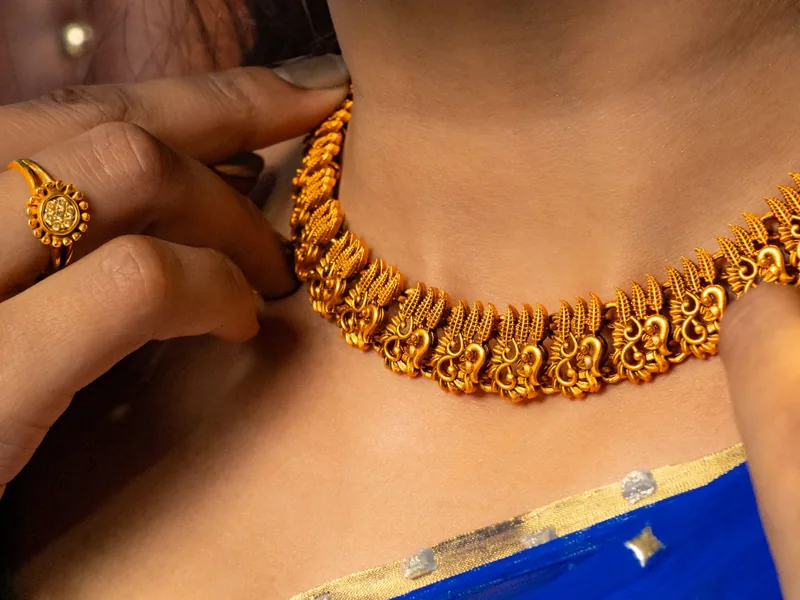

For daily wear, most women do well with a 22K or 18K gold chain of roughly 8 to 16 grams, in a box, rope or curb pattern, closed with a lobster clasp and carrying a BIS hallmark with a HUID. The price is the net gold weight at the day's rate, plus the making charge, plus 3 percent GST on the whole bill.
Most buyers compare price tags. The number that tells you whether a deal is fair is the final bill divided by the net grams. The calculator below takes the day's rate and a shop's quote, and every rupee figure in the worked sums on this page uses an example rate of ₹13,500 per gram for 22K gold. It is an example, not today's rate.
What weight of gold chain for women suits daily wear?
There is no official definition of a light chain, so we lean on what jewellers publish. BlueStone's weight guide (November 2025) sorts women's chains by use. The bands below are its figures, not a rule.
| Use | Weight band in that guide |
|---|---|
| Daily wear and office | 8 to 16 grams |
| College and light parties | 16 to 25 grams |
| Engagement and small functions | 26 to 40 grams |
| Wedding and heavy looks | 41 to 80 grams or more |
The same guide warns that anything over 40 grams starts to feel heavy on a woman's neck after three or four hours. Our stance: if you will wear it every day, stay in the first band. A chain you forget you are wearing gets worn, while a heavy one ends up in the locker.
For gifting, the daily-wear band is also the kinder one for the budget. BlueStone calls a 30 gram chain the safe wedding gift, which is a bigger spend. Whichever weight you choose, hand over the invoice and the hallmark details with the box, so the person who wears it can verify or exchange it later.
Which chain type suits women: rope, box, curb, Singapore or Italian?
Chain names describe how the links are joined, and the join decides how well a chain survives daily life.
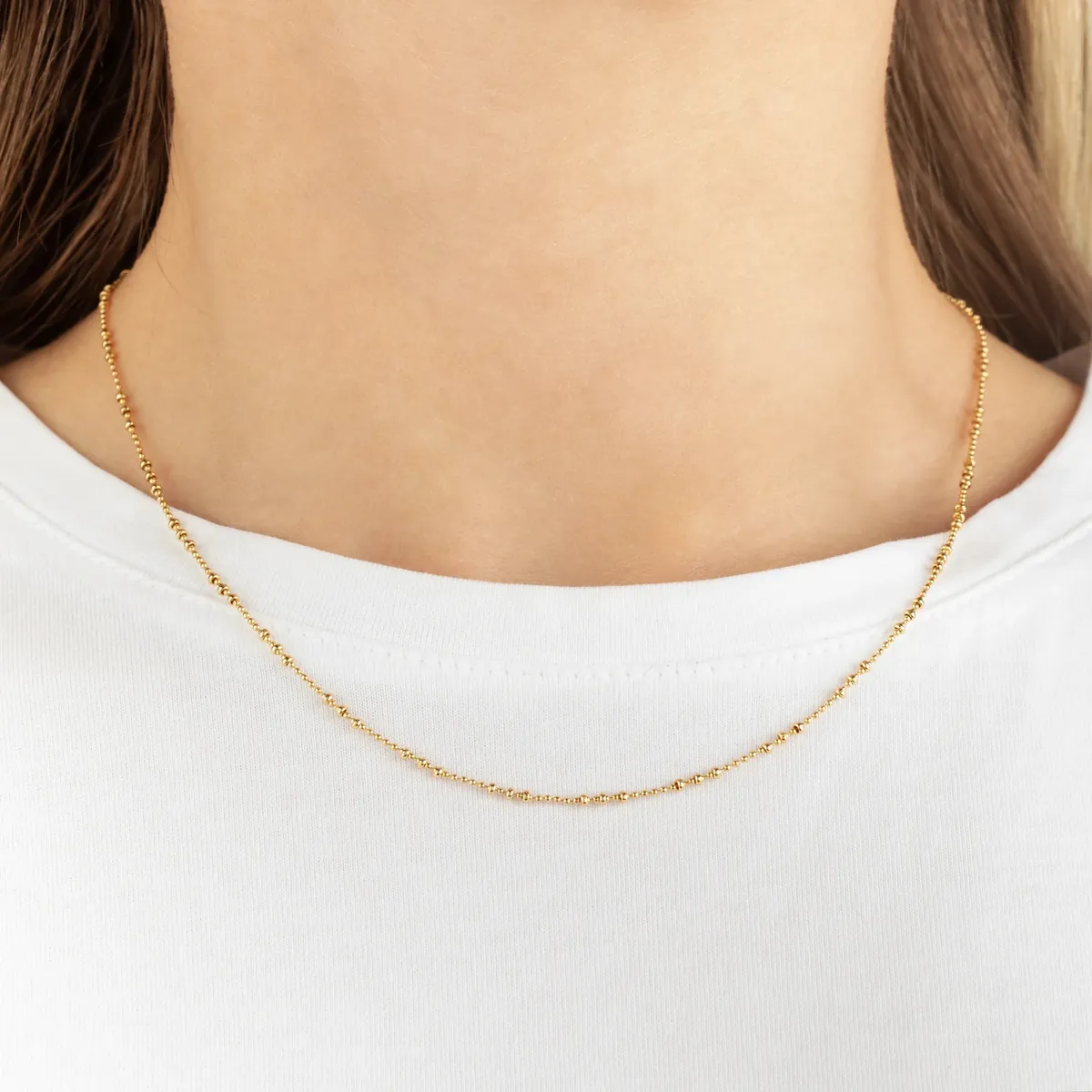
- Box chain. Square links in a smooth line. GIVA's guide (November 2025) lists box and rope chains among the most durable styles, and a thin box carries a small pendant well.
- Rope chain. Twisted strands that catch the light. Durable, and a common choice for festive wear.
- Curb chain. Flat, interlocking links that lie neatly against the skin. A thin curb is a refined everyday piece, and the pattern is generally rated as sturdy.
- Singapore chain. Finely twisted links with a bright sparkle. Some guides rate it as the more delicate of the group, so keep it for light wear and skip heavy pendants.
- Italian chain. A style label rather than a link pattern, and it can be solid or hollow. That is the question to ask.
A hollow chain is made from a thin gold tube shaped into links, so it is lighter and cheaper than a solid chain with the same look. Jewellers' guides agree that hollow links dent more easily and are harder to repair, and one cautions that weight alone cannot tell you whether a chain is solid or hollow.
So ask, and have the answer written on the invoice. If it is hollow, do not pay a solid chain's making charge for it.
For a first everyday chain, a thin box or curb in a medium length is the low-regret choice.
How is the price of a gold chain built?
Three lines make the bill: gold value (net weight times that day's rate), the making charge, and GST at 3 percent on the total, making charge included. The CBIC's FAQ on gems and jewellery gives the example of a ₹30,000 chain with ₹2,000 of making charges, where the tax is ₹900.
If you bring your own gold, GST is extra on the making charge: ask the goldsmith for the rate and get it on the bill. BIS raised the gold hallmarking fee to ₹75 per article plus taxes in September 2026 (some BIS pages still show the older ₹45); the jeweller pays it, so ask for it as its own line, and check the current fee.
Here is a 10 gram 22K chain at the example rate, priced two ways. Every figure is an example.
| Line (example) | Quote A: ₹250 per gram making | Quote B: 8 percent making |
|---|---|---|
| Net weight | 10 g | 10 g |
| Gold value at ₹13,500 per gram | ₹1,35,000 | ₹1,35,000 |
| Making charge | ₹2,500 | ₹10,800 |
| Subtotal | ₹1,37,500 | ₹1,45,800 |
| GST at 3 percent | ₹4,125 | ₹4,374 |
| Total, before the ₹75 hallmark fee | ₹1,41,625 | ₹1,50,174 |
| Total per gram, before the hallmark fee | about ₹14,163 | about ₹15,017 |
Same chain, same gold, ₹8,549 apart. The whole gap is the making charge and the GST that rides on it.
What do shops usually charge? Published guides disagree, and that is worth knowing. Aditya Birla Capital's per-gram guide (posted 22 May 2026, updated 12 October 2026) lists plain gold chains at ₹150 to ₹250 per gram, with machine-made chains at the lower end.
IIFL's guide (15 July 2026) puts chains at 6 to 14 percent of gold value. Londe Jewellers in Nagpur published a dated survey on 8 June 2026, when 22K was ₹14,160 per gram, and put plain 22K chains at ₹220 to ₹650 per gram depending on whether the shop was an old-market sarafa, a branded showroom or a mall counter.
Londe is itself a jeweller, so treat its figures as one seller's view. On our arithmetic (220 and 650 divided by 14,160) that is roughly 1.6 to 4.6 percent of gold value.
Three sources, three answers, and none is an official rate. Use them to spot a quote that is far out of line, then compare real totals. IBJA's published rates also exclude GST and making charges, so a shop's price will always sit above them.
Machine-made or handmade: which is worth paying for?
Machine-made chains come out in volume with even links and a consistent finish, so the labour per piece is lower. IIFL puts plain machine-made patterns at about 6 to 9 percent, and heavier or handcrafted chains at about 12 to 14 percent. Aditya Birla Capital also notes that machine-made chains attract lower charges.
On the example chain, a 7 percent charge is ₹9,450 and a 13 percent charge is ₹17,550. That is ₹8,100 of difference before GST. It is fair to pay it when the pattern is the point, for example a detailed hand-finished design. It is not fair to pay it for a plain box chain that came off a machine, so ask how the chain was made.
18K or 22K for a gold chain?
22K is 91.6 percent gold and carries the mark 22K916. 18K is 75 percent gold and carries 18K750. Jewellers' own guides, including Tyaani's and BlueStone's, describe 18K as more resistant to scratching and bending, and 22K as the softer metal. A chain bends and rubs more than most jewellery, so this matters.
The money side cuts the other way. A 10 gram 18K chain holds about 18 percent less gold than a 10 gram 22K chain (75 divided by 91.6), so the gold value is lower. But Aditya Birla Capital lists 18 carat making charges at ₹400 to ₹800 per gram, against ₹150 to ₹500 for 22 carat, so compare totals and not headlines.
Our stance: a thin chain worn daily is a good case for 18K. A chain you also see as savings, or want for tradition, suits 22K. Our 22K vs 24K guide covers the purity sums in more detail.
What should you check on the clasp, the links and the length?
A chain usually fails at the clasp or the small ring beside it, not in the middle. Jewellers' guides rate the lobster clasp as more secure than the spring ring, which suits lighter chains if it is checked regularly. Open and close the clasp several times in the shop, and ask the jeweller to solder the small jump ring closed on anything valuable.
Then hold the chain up and let it hang. It should fall straight, with even links and no kinks or stiff joints. Thin and hollow chains kink first, so keep each chain in its own pouch to stop tangles. Check jewellery pouches for chains on Amazon
For length, GIVA's guide suggests 14 to 20 inches for women. Jewellers' length guides place 16 inches at about the collarbone, 18 inches (the most common pick) on or just below it, and 20 inches on the upper chest. Cut a piece of thread to each length and hold it round your neck before you decide, because neck size and pendant size change where a chain lands.
How do you compare two shops fairly?
Ask both for the same things in writing: net weight, carat, the gold rate used, the making charge and how it is calculated, the hallmark charge, the GST line and the final total. Then divide the total by the net grams. A shop with a higher gold rate can still be cheaper overall.
| Example quote, 10 g 22K chain | Shop 1 | Shop 2 |
|---|---|---|
| Rate used | ₹13,500 per gram | ₹13,600 per gram |
| Gold value | ₹1,35,000 | ₹1,36,000 |
| Making charge | 6 percent, ₹8,100 | ₹400 per gram, ₹4,000 |
| GST at 3 percent | ₹4,293 | ₹4,200 |
| Total | ₹1,47,393 | ₹1,44,200 |
Shop 2 uses the higher gold rate and still wins by ₹3,193. Comparing only the rate, or only the making percentage, would have picked the wrong shop. Also ask whether the making charge is on net or gross weight. For a plain chain they match, but for a stone-set pendant they do not, and our making charges guide explains how to read that line.
Hallmark, HUID and buyback: what to check before you pay
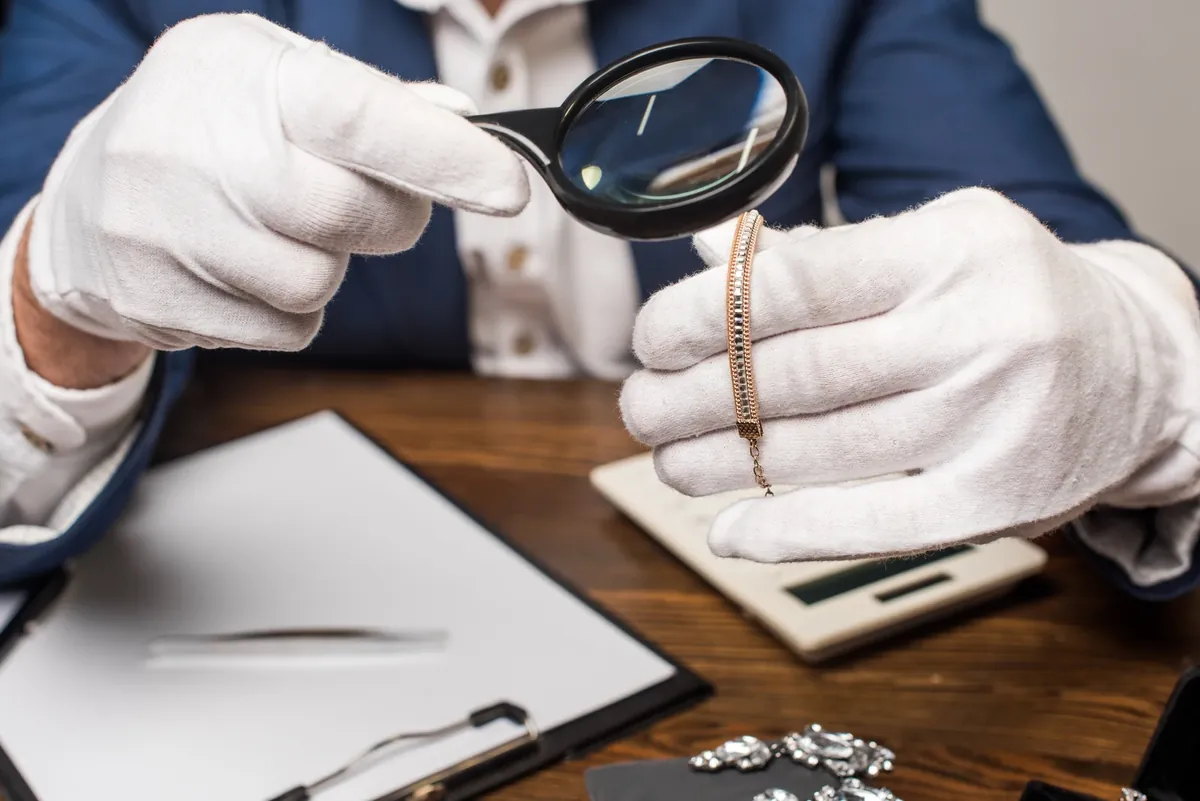
A BIS hallmark on gold jewellery has three parts: the BIS logo, the purity mark (22K916 or 18K750) and a six-character alphanumeric HUID. Open the BIS Care app, choose Verify HUID and enter the code, and the app shows the jeweller's registration details. Our guide to checking HUID and hallmark walks through it step by step, and BIS publishes the rules at bis.gov.in.
Mandatory hallmarking applies in the districts BIS has notified: 380 from 2 March 2026, extended by later orders (a Third Amendment Order of 3 August 2026 took coverage to 392 districts, according to Business Standard), so check the current BIS list for your district.
Exemptions cover jewellers with turnover up to ₹40 lakh, pieces under 2 grams, and Kundan, Polki and Jadau jewellery. So a missing hallmark is not always a breach, but it is always a reason to ask. If a hallmarked piece turns out to be below its marked purity, BIS says the buyer is entitled to two times the money value of the shortfall in purity for the weight sold, plus the testing charges, so keep the invoice.
Before you pay, ask these buyback questions and keep the answers on the invoice or in a message:
- Will you buy this chain back, or only exchange it against new jewellery?
- At what rate: the day's published rate or your own?
- What deduction applies, and is it the same if I bought the chain elsewhere?
- Are the making charge and GST returned? (Generally they are not.)
- Do I need the original invoice and the hallmark details?
Frequently asked questions
How many grams should a gold chain for women be for daily wear?
One jeweller's published guide puts daily wear and office chains at 8 to 16 grams. There is no official definition, so choose the lightest weight that still looks right to you, and compare the net weight on the invoice.
Is 18K or 22K better for a gold chain?
Jewellers' guides describe 18K (18K750) as more resistant to scratching and bending, and 22K (22K916) as softer but richer in gold. For a thin chain worn daily, 18K is a practical choice. For a chain you also treat as savings, 22K is the traditional pick.
What making charge is normal on a gold chain?
There is no official rate. Aditya Birla Capital lists plain chains at ₹150 to ₹250 per gram, IIFL quotes 6 to 14 percent of gold value, and Londe Jewellers' June 2026 Nagpur survey (one seller's view) gave ₹220 to ₹650 per gram. Ask for the total and compare it with a second shop.
Does every gold chain need a HUID?
Mandatory hallmarking applies in notified districts, and jewellers with turnover up to ₹40 lakh, pieces under 2 grams and Kundan, Polki and Jadau jewellery are exempt. Where it applies, the piece carries the BIS logo, the purity mark and a six-character HUID that you can check in the BIS Care app.
Do I get my money back if I sell a gold chain?
You generally get the value of the pure gold at that day's rate, less any deduction the jeweller applies. Making charges and GST are generally not returned, so read the buyback terms before you buy.
Your next step: pick a weight band and a pattern, then ask two shops for a written quote with net weight, rate, making charge and total. Put those numbers into the calculator above, and read our guides to gold making charges, HUID and hallmark checks and mangalsutra designs before you pay.
We may earn a commission if you buy through links on this page, at no extra cost to you. As an Amazon Associate I earn from qualifying purchases. How we earn