The best moisturiser for dry winter skin is usually a fragrance-free cream or ointment rather than a thin lotion, applied within minutes of a short bath while your skin is still damp. Look for a humectant such as glycerin to pull water in, plus an emollient or occlusive such as petrolatum or shea butter to slow its loss, and add ceramides or urea if your skin needs more.
Indian shoppers often search for the best moisturizer for dry skin as if one product wins everywhere. None does: the right choice depends on how cold and dry your winter is, whether the product is for face or body, and how your skin reacts to fragrance. This guide shows how to choose, what the evidence says about common ingredients, and a simple routine. It is general skincare information, not medical advice.
Why does winter dry out your skin?
Cold air holds less moisture than warm air, and winter habits add to the problem: long hot showers, indoor heating, frequent hand-washing and harsh soaps. The effect is strongest where winters are coldest. January nights average about 7.5°C in Delhi but about 16.9°C in Mumbai, according to India Meteorological Department normals for 1991 to 2020 as tabulated on each city's Wikipedia page.
In milder cities such as Mumbai, Bengaluru and Hyderabad, dry patches often come from air conditioning, hot water and frequent washing rather than from cold. The routine below works in both cases. Only the thickness of the product changes.
Cream, lotion, ointment or oil: which is best?
For dry skin, a cream or an ointment beats a lotion. The American Academy of Dermatology (AAD) says ointments and creams add more moisture to skin and are more effective than lotions. The NHS describes the same range: lotions are thin and spread easily but are less moisturising, creams are less greasy and suit daytime, and ointments are the thickest and suit very dry skin and night use.
| Type | Texture | Best for | Trade-off |
|---|---|---|---|
| Lotion | Thin, spreads easily | Mild dryness, large areas, mild winters | Less moisturising, so you may reapply often |
| Cream | Thicker, less greasy | Daily face and body care in most winters | Heavier than a lotion; check for fragrance |
| Ointment, such as plain petroleum jelly | Thickest and greasy | Very dry hands, heels and elbows, and night-time | Feels greasy, so use a thin layer |
| Oil | Oil only, no water | A top layer over a cream or damp skin | Slows water loss but does not add water |

Body butters, balm sticks and body oils are textures, not categories, so read the ingredient list to see what is really in them. If water is the first ingredient, it behaves like a cream or lotion. If the product is mostly oils and waxes, it behaves more like an ointment. Check fragrance-free moisturising creams on Amazon

Which ingredients help, and what does the evidence say?
Ingredient lists can read like a chemistry exam, so here is the cheat sheet. Most good moisturisers combine three jobs: pull water in (humectants), soften the surface (emollients) and seal water in (occlusives). DermNet, a dermatologist-run reference, lists glycerine and urea as humectants, and petroleum jelly, paraffin, mineral oil and dimethicone as occlusives.
The AAD's own list of ingredients to look for adds hyaluronic acid, lactic acid, lanolin, jojoba oil and shea butter.
| Ingredient | Job | What to know |
|---|---|---|
| Glycerin | Humectant | A long-established ingredient found in products at every price, and on the AAD list |
| Petrolatum | Occlusive | The base of petroleum jelly. Dermatology reviews describe it as one of the most effective occlusives. It seals water in rather than adding it |
| Shea butter | Plant fat that softens and seals | On the AAD list. The research is thinner than for petrolatum and mostly small or laboratory studies |
| Ceramides | Fats that occur naturally in the outer layer of skin | Small studies, mostly in people with eczema, report better skin hydration. The evidence is thinner than for glycerin and petrolatum, so treat them as a reasonable extra |
| Urea | Humectant; stronger forms also loosen dead skin | Reviews describe low strengths (below about 10%) as mainly moisturising and higher strengths (10% to 40%) as also keratolytic, which means they loosen the dead outer layer. DermNet notes urea can sting cracked or scratched skin |
| Hyaluronic acid | Humectant | On the AAD list. Published studies are mostly small and some are funded by makers, so it is a nice extra, not a reason to pay more |
How do you choose for your skin type and city?
Dry North Indian winter
In Delhi, Punjab, Uttar Pradesh and the hills, use a cream or ointment on the body, a thicker layer at night, and plain petroleum jelly on hands, heels and elbows. The AAD suggests gloves in cold, dry weather and a humidifier in the bedroom, cleaned regularly to prevent mould.
Mild southern and coastal winter
In Mumbai, Bengaluru and Hyderabad, a lotion or light cream is often enough. Put your effort into shorter baths and moisturising after time in air-conditioned rooms.
Oily or combination skin
Oily skin can still feel tight in winter. Use a light, fragrance-free gel or lotion made for faces on your face, and keep body creams and heavy ointments for the body, since they are not designed for facial skin.
Sensitive skin
Choose fragrance-free products with short ingredient lists and patch test first. If a product burns or stings, stop using it.
Should you worry about fragrance, patch tests and SPF?
Fragrance. The AAD advises choosing products labelled "fragrance-free". It warns that "unscented" products can contain chemicals that neutralise or hide the smell of other ingredients. DermNet adds that preservatives in moisturisers can cause allergic reactions in people who are already sensitised. If the ingredient list says "parfum" or "fragrance", the product is scented.
Patch test. The AAD advises applying a small amount of a new product to your inner forearm twice a day for four to five days before using it more widely, and for seven to ten days if you are prone to rosacea (its general product-testing guide also says seven to ten days).
DermNet describes a similar repeat test, twice a day for five to ten days. A single 24-hour test can miss a delayed allergy, because reactions can take days to appear. Stop if you see redness, itching, swelling, burning or blisters.
The AAD asks you to tell a dermatologist if any product, including a moisturiser, causes burning, stinging or irritation.
SPF. The AAD recommends a broad-spectrum, water-resistant sunscreen with an SPF of 30 or higher, applied every day to skin that clothing does not cover when you will be outside. The sun's UV does not switch off in winter, so on bright days use it on exposed skin such as your face and hands.
A moisturiser with SPF can save a step, but only if it states SPF 30 or higher and broad spectrum, and ideally water resistant. Check SPF 30 sunscreens on Amazon
What is a simple daily routine?
- Keep showers short and warm. The AAD advises five to ten minutes in warm water, a gentle cleanser only where needed, and closing the bathroom door to keep moisture in.
- Pat dry. Use a clean towel and do not rub.
- Moisturise while skin is still damp. Apply after a bath, after washing your hands, and whenever skin feels dry. The AAD says to apply moisturiser several times a day.
- Use a thicker product at night on hands, heels and elbows.
- Protect your hands. Wear gloves to wash dishes and in cold, dry weather.
- Add sunscreen by day on skin that is exposed.
It sounds fussy, but it takes less time than finding the other earring.
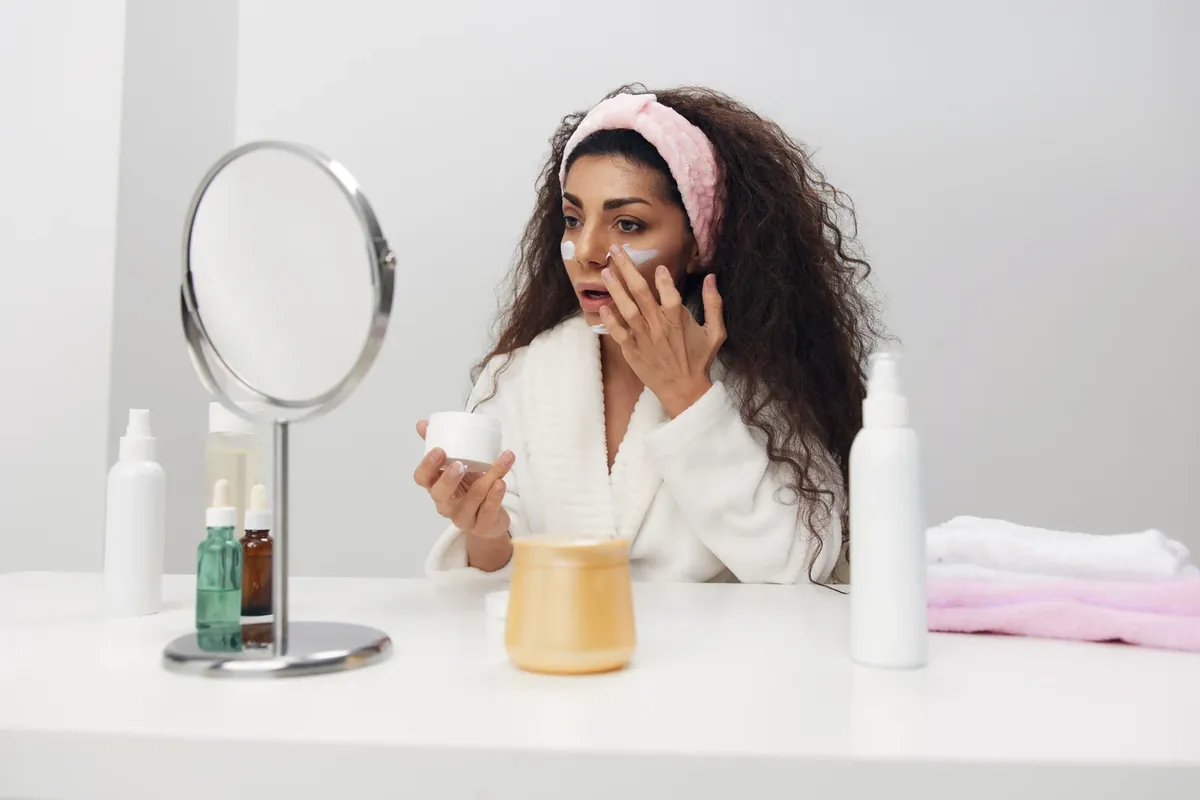
For hygiene, the NHS advises not dipping your fingers into the pot; use a clean spoon or a pump. For safety, the NHS warns that emollients can make clothing and bedding catch fire more easily, so keep clear of heaters, angithis, candles and lit diyas. Never leave a lit diya or candle unattended, and keep them away from children, curtains and dupattas.
What should you buy at each budget, and what should the label say?
Think in monthly spend rather than the price of one product. Prices change often, so check the current price and pack size. At every tier, pay for the formula, not the packaging.
Up to ₹300 a month
One fragrance-free body lotion or cream with glycerin for the whole body, plus plain petroleum jelly for hands, heels and elbows, can be enough for a mild winter. Check body lotions for dry skin on Amazon
₹300 to ₹800 a month
Add a thicker cream for night or very dry patches, and a separate moisturiser made for your face. Look for ceramides or urea in the ingredient list if you want them. Check ceramide creams on Amazon
Above ₹800 a month
Extra spend makes sense when your skin has a specific need: a fragrance-free formula for sensitive skin, a moisturiser with SPF 30, or a product a dermatologist has suggested. Price alone tells you little about how well a moisturiser works, so read the ingredient list.
Check these on the pack before you buy:
- Ingredient list. Ingredients are usually listed from the highest amount to the lowest, so the first few tell you most.
- "Fragrance-free", not "unscented". Watch for "parfum" or "fragrance" in the list.
- Maker details, dates and price. India's Cosmetics Rules, 2020 (rule 34) call for the manufacturer's name and address, a use-before or expiry date, the batch number, the manufacturing licence number, the net contents and the ingredient list on the label, according to compliance summaries. The MRP comes from the Legal Metrology (Packaged Commodities) Rules, not the Cosmetics Rules. If any of these is missing or smudged, return it.
- Open-jar symbol. A jar icon with a number and "M", such as 12M, shows the months a product is meant to be used after opening.
- Pump or tube over a jar when you can, so fingers stay out of the product.
When should you see a doctor?
Moisturisers are everyday skincare, not a treatment for skin conditions. See a doctor or dermatologist if dryness continues despite a steady routine, if skin is cracked and bleeding, or if itching does not settle. Seek urgent advice if an area is painful, swollen, warm, blistered, crusty or leaking fluid, or if you feel unwell or have a fever, which the NHS lists as warning signs with eczema.
The AAD notes that persistent dry skin can come from conditions such as atopic dermatitis, psoriasis or kidney disease, and asks you to check with a dermatologist before using anti-itch creams.
For babies, children and pregnancy, ask a paediatrician or doctor before choosing products.
Frequently asked questions
What is the best moisturiser for very dry skin in winter?
A fragrance-free cream or ointment that combines a humectant such as glycerin with an occlusive such as petrolatum, applied to damp skin after a short warm bath. Add ceramides or urea if you want them.
Is body lotion enough for winter?
For mild winters, often yes. The NHS describes lotions as thin and less moisturising than creams and ointments, so in cold, dry places use a cream or ointment, at least on hands, heels and elbows.
Is hyaluronic acid or ceramide better?
Neither is essential. Both appear in good moisturisers, but the evidence behind each is mostly small studies. Look first for glycerin, petrolatum and a fragrance-free formula, then treat the others as extras.
Do I need sunscreen in winter?
The AAD recommends broad-spectrum, water-resistant sunscreen of SPF 30 or higher, applied every day to skin that clothing does not cover when you are outside. UV does not disappear in winter, so use it on exposed skin on bright days, especially if you spend time outdoors.
How often should I moisturise?
The AAD advises several times a day: after a bath while skin is damp, after washing your hands, and whenever skin feels dry.
Your next step: tonight, start a patch test of one fragrance-free cream on your inner forearm, twice a day for four to five days (seven to ten if you are prone to rosacea), and meanwhile moisturise within minutes of your bath with a product your skin already tolerates. If you are preparing skin for an occasion, our Karwa Chauth makeup look, step by step has a simple prep routine, and our guide to winter wear for women covers staying warm once the cold arrives.
This article is general information, not medical advice. Speak to a doctor or another qualified professional about your own health.
We may earn a commission if you buy through links on this page, at no extra cost to you. As an Amazon Associate I earn from qualifying purchases. How we earn