Karwa Chauth 2026 is on Thursday 29 October in India and the UK, and Wednesday 28 October in the US and Canada (Drik Panchang). Married women fast from sunrise, with no food or water, until they see the moon, offer it water and break the fast with water and a sweet, traditionally from their husband. Check your own city's moonrise before the day.
When is Karwa Chauth 2026?
The date depends on where you are. India keeps Thursday 29 October because Chaturthi (about 1:06 AM to 10:09 PM IST) is running when the moon rises. New York and Toronto keep Wednesday 28 October because Chaturthi begins there at 3:36 PM, before moonrise.
London is the awkward case: Chaturthi has ended by Thursday's moonrise and has not begun by Wednesday's, so Drik falls back to Thursday 29 October. UK families should confirm with their temple.
If you live outside India, check the day for your own city before you plan. In North America the moonrise-in-Chaturthi rule gives Wednesday 28 October, while in India and the UK Drik gives Thursday 29 October. Elsewhere, check your local temple or Drik Panchang for your city. Our guide to Karwa Chauth abroad: which day and moonrise by city goes through it.
Karwa Chauth is kept on the fourth day (Chaturthi) of the waning moon, the Krishna Paksha, in the month of Kartik by the North Indian calendar. Some calendars name the same month Ashvin, which is why the festival can appear under either name. It always falls in October or November, a little over a week before Dhanteras (6 November) and ten days before Diwali (8 November) this year.
The box above shows puja and moonrise times for major cities. For any other town, use Drik Panchang and write the moonrise time on the fridge.
What is Karwa Chauth and who keeps the fast?
Karwa Chauth is a one-day vrat (votive fast) observed mainly in Northern and Western India. Married women traditionally fast for their husband's long life and wellbeing. The name comes from karva, a small earthen pot with a spout, and chauth, which means the fourth day.
It is not only for wives. Drik Panchang describes the fast as one kept by married women for their husband's long life, but customs are wider than that: in some families unmarried women keep it as well and pray for a good life partner.
Many husbands now fast alongside their wives too. Nobody is required to fast to belong to the day: plenty of women join the evening gathering, wear the shringar and skip the fast.
Who is worshipped? Drik Panchang describes worship of Lord Shiva, his family and Lord Ganesha, and the moon is honoured with an offering of water. In Rajasthan a Gaur Mata image was traditionally used, and today it is often a picture of Parvati. Use whatever your family has always used.
What are the Karwa Chauth fasting rules?
The traditional fast is strict: no food and no water from sunrise until the moon is sighted and the offering is made. This kind of fast is called nirjala, which means without water. It is broken only after moonrise.
The day begins before dawn with sargi, a meal eaten before sunrise. Traditionally the mother-in-law prepares it or sends it, and it commonly includes fruit, sweets such as pheni, and dry fruits. Our full list is in the Karwa Chauth sargi items checklist.
Once the sun is up, the usual rules are:
- No food or water until moonrise and the moon offering (strict version).
- Many women avoid housework during the day, a custom that varies by family.
- The day is for mehndi, dressing up, meeting friends and getting the thali ready.
- The puja is done in the late afternoon or evening, before the moon appears.
A health caution. A waterless fast of twelve hours or more is not right for everyone. If you have diabetes, are pregnant or breastfeeding, have low blood pressure, kidney problems or any other medical condition, or take regular medication, speak to your doctor before fasting.
Traditions allow flexibility in these cases, and your devotion does not depend on going without water. If you feel dizzy, faint or unwell during the day, stop and drink something. Health comes first.
What happens during the day, hour by hour?
The day follows a rhythm that most families recognise, even where details differ.
- Before sunrise: wake up, eat sargi and drink plenty of water. The fast begins at sunrise.
- Morning: bathe, wear fresh clothes and apply mehndi if you have not already done so the day before. Many women also begin the shringar, the traditional adornment of a married woman, including bangles, bindi and jewellery.
- Afternoon: rest. This is the hardest stretch, so keep the day light. Set up the puja thali and the altar space.
- Late afternoon or evening: dress up and gather with other women for the katha and puja, at the time your panchang gives for your city.
- Moonrise: go to the terrace, balcony or a clear open spot, see the moon, offer water and break the fast.
- After the fast: eat a light first meal, then a family dinner.
If you want a look to match the day, our Karwa Chauth makeup look, step by step is a good place to start.
What do you need for the Karwa Chauth puja thali?
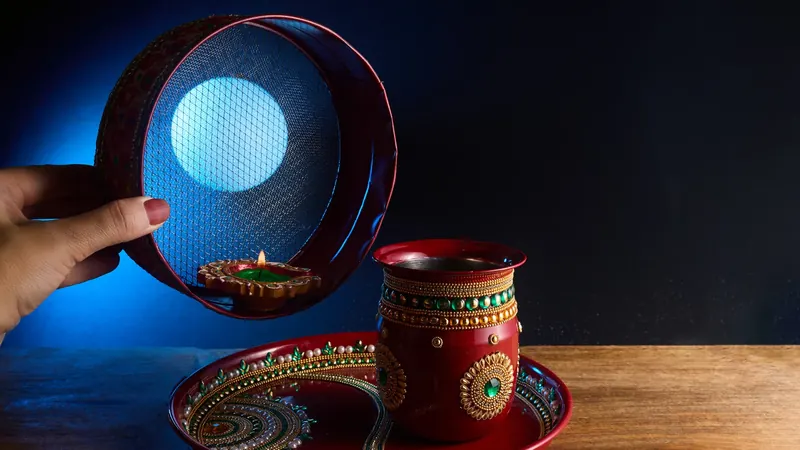
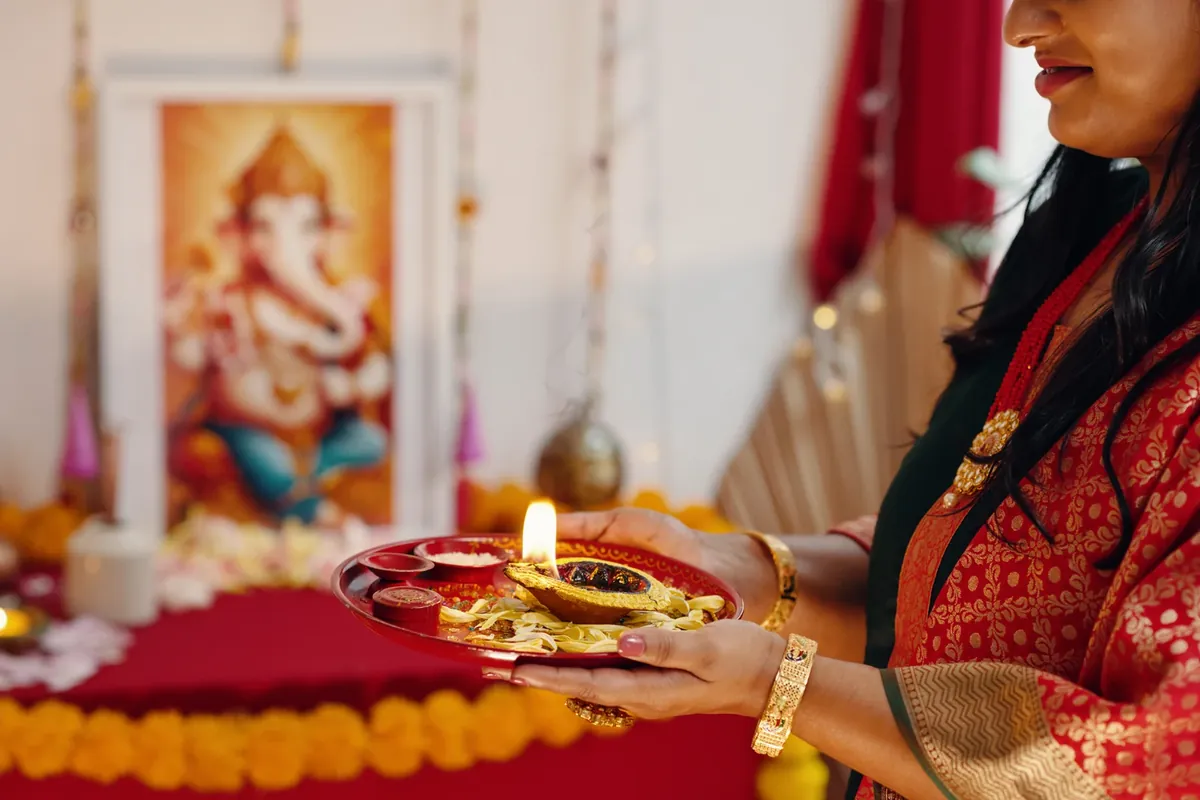
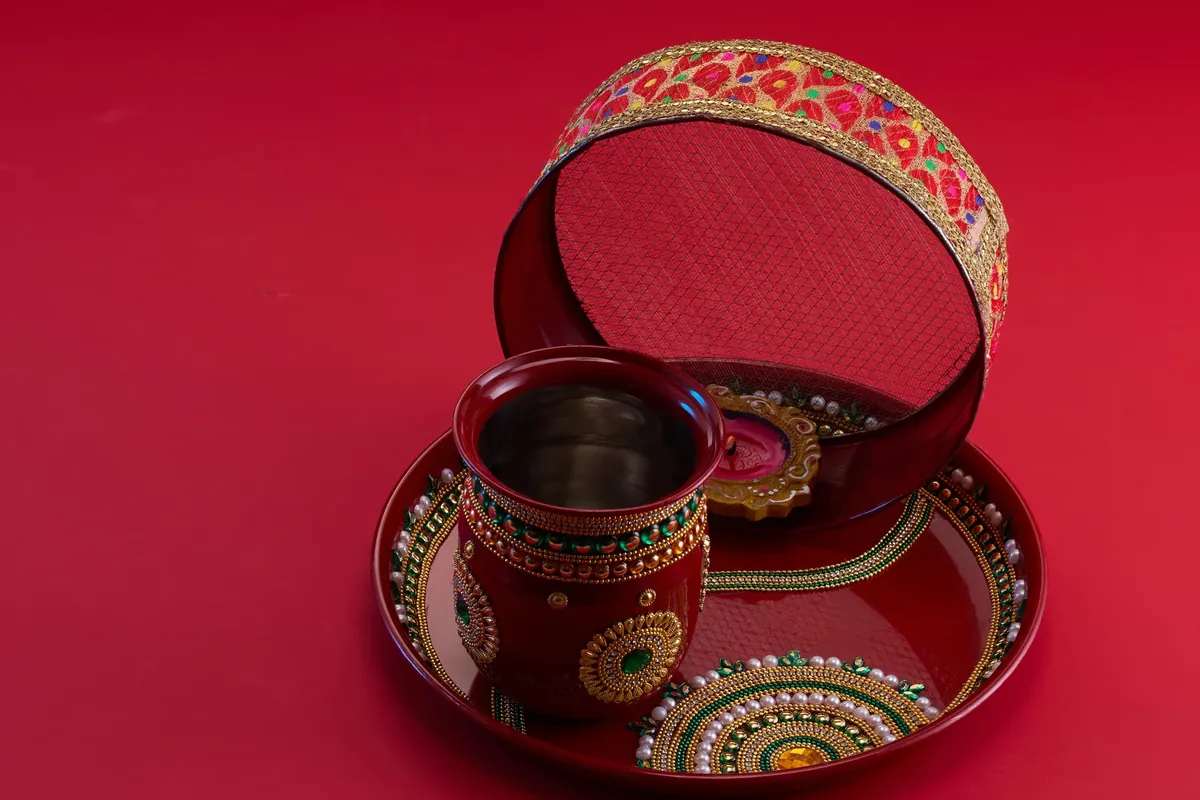
A basic puja thali holds the karwa (water pot), a diya, a sieve, sweets and water for the offering. Sources describing the puja commonly mention a Ganesha image for blessings, a lota for pouring water, mathri and sweets, and roli (red powder), rice grains and fruit. Families add or drop items, so use this as a starting point.
- Karwa: a pot with a spout used to offer water to the moon. Many families use an earthen one, and decorated metal ones are widely sold. Check Karwa Chauth thali sets on Amazon.
- Chalni (sieve): to view the moon and then your husband. A new, clean sieve is usual. Check decorated chalni on Amazon.
- Diya and ghee or oil: to light on the thali.
- Roli, rice (chawal), flowers and fruit: for tilak and offerings.
- Sweets and mathri: offered to the moon and used for the first bite after the fast.
- Lota of water: for the arghya, the water offering to the moon.
- Picture or idol of Shiva, Parvati and Ganesha: or whichever deity your family worships.
If you are buying, keep one thing in mind: the thali should be easy to carry and wash. Heavy stone-studded ones look lovely but can scratch and be awkward to hold when you are hungry and tired. Our Diwali puja samagri list overlaps with many of these items, so buy once and use twice.
What is the Karwa Chauth puja vidhi, step by step?
The vidhi below is a general sequence that most North Indian sources describe. Your family's order of events may differ, so follow the elders at home where they have a set way.
- Prepare the space. Clean a small area and set up the images of the deities, often on a chowki covered with a red cloth.
- Arrange the thali. Place the karwa filled with water, the diya, roli, rice, sweets and the sieve on the thali.
- Dress and gather. Women usually sit in a circle with their thalis, in bridal-style shringar.
- Light the diya and worship. Offer tilak, flowers and sweets to the deities, and pray for the wellbeing of the family.
- Listen to the vrat katha. An elder or the priest reads or tells the story, while the thalis are passed around the circle. In parts of Uttar Pradesh and elsewhere, women exchange their karwas seven times during the katha.
- Wait for the moon. Go to a clear spot with the thali. Some women stand on a wooden plank or remove their shoes, as some guides describe.
- See the moon through the sieve. Look at the moon through the chalni with the lit diya behind it, pray, and offer arghya by pouring water from the karwa or lota.
- Look at your husband through the same sieve. Then he gives you water and the first bite of sweets, which ends the fast.
- Take blessings. Touch the feet of elders. In many families the in-laws' gift, called baya, is given at this point or earlier in the day.
How do you break the fast safely?
Break the fast with water first, taken slowly, then something light. Gulping a large glass on an empty stomach can make you feel sick. Coconut water, a soaked almond or two, fruit, or a little milk are gentle choices, and nutritionists commonly suggest saving heavy, oily or very spicy food for a little later. Tea and coffee on a completely empty stomach can aggravate acidity for some people.
After that, dinner can be whatever your family has planned. The traditional first bite is a sweet given by the husband, so have a small one ready.

What is the Karwa Chauth story?
The most commonly told story is that of Queen Veeravati, the only sister of seven brothers. During her first Karwa Chauth she became weak from hunger. Her brothers, unable to bear it, tricked her by showing a false moon, using a mirror or a lamp behind a sieve or tree.
She broke the fast, and her husband fell ill or died, depending on the version. She kept the fast with complete devotion the following year, and her husband was restored.
Other tales are told alongside it. In one, Draupadi keeps the fast on Krishna's advice to help the Pandavas through trouble. In another, a devoted wife saves her husband from a crocodile and compels Yama, the god of death, to release him. Families hold whichever story they grew up with, and that is fine.
How do traditions differ by region?
The core of the day, sargi, fast, evening puja, moon and husband's water, is shared across North India. The details are not.
- Punjab: the sargi tradition is strongest, often with fenia (a vermicelli sweet) sent by the mother-in-law.
- Rajasthan: older women tell stories involving Shiva, Parvati and Ganesha, and there is a call-and-response before the water is offered.
- Uttar Pradesh: clay idols of Shiva, Parvati and Ganesha are decorated, and karwas are exchanged seven times.
- Newly married women: in some families the first Karwa Chauth is celebrated at the bride's mother's house, with the sargi sent there by the mother-in-law.
Outside India, families keep to the same pattern and simply adapt: a balcony, garden or window view of the moon, and the muhurat and moonrise for their own city rather than for Delhi.
What if the moon is hidden by clouds?
Cloud cover is common and there is no single rule. Check your city's moonrise time in a panchang, wait a little past it and offer the water facing the direction where the moon should be rising, then ask an elder or your family priest what your family's custom is. Do not break the fast early on a guess.
Next: how to open your Karwa Chauth fast, step by step, gift ideas for a husband, which day to fast abroad and the 2026 to 2027 festival calendar.
Frequently asked questions
What is the date of Karwa Chauth in 2026?
Drik Panchang lists Thursday 29 October 2026 for New Delhi and London. Its New York and Toronto pages list Wednesday 28 October, because Chaturthi is running at that evening's moonrise there. Check a local panchang or Drik Panchang for your city.
Can you drink water during the Karwa Chauth fast?
The traditional fast is nirjala, with no food or water from sunrise until the moon is sighted. People with medical conditions, pregnant women and others often modify it on their doctor's advice, and traditions allow flexibility for them.
Can unmarried women keep Karwa Chauth?
Drik Panchang describes the fast as kept by married women, but in some families unmarried women keep it too, praying for a good life partner. Customs differ, so follow your family.
Can husbands keep Karwa Chauth too?
Many husbands fast alongside their wives today, as a gesture of support. It is a personal choice rather than a rule, and the same medical cautions apply.
When should you eat sargi?
Before sunrise, ideally with fruit, nuts and something that keeps you full. Drink plenty of water at the same time, because the fast begins at sunrise. Check your local sunrise time on your city's panchang.
This week, find out your city's moonrise time and puja muhurat on Drik Panchang, and put your thali together early so the day itself feels calm. For the next steps, read our Karwa Chauth sargi items list, plan her day with the Karwa Chauth gift for wife guide, and see how it fits the festive week in Diwali 2026: the five days, from Dhanteras to Bhai Dooj.
We may earn a commission if you buy through links on this page, at no extra cost to you. As an Amazon Associate I earn from qualifying purchases. How we earn