For Diwali rangoli, the easiest choice for most homes is a plastic stencil with dry rangoli powder at the doorway, flower petals for a balcony or small space, and a reusable sticker or an urli bowl of floating flowers where you cannot, or would rather not, make a mess. Powder gives the sharpest design, flowers are the easiest to clear up, and a sticker or a bowl suits a rented flat or a windy balcony.
Diwali falls on Sunday 8 November 2026 (check your local panchang). Rangoli is most often made during Diwali, and the custom is to welcome Lakshmi, so many families put one at the entrance for the festival. This guide covers the types of rangoli, six simple designs described in words, which colours to trust, what to buy, small-space ideas, wind and rain, and clean-up.
What are the main types of rangoli, and which should you buy?
Choose the type by where it will sit, not by how it looks in a photo. A doorway, a balcony, a tiled hall and a rented flat each suit a different material.
| Type | Best for | Watch out for | Clearing up |
|---|---|---|---|
| Dry powder with a stencil | Sharp designs, doorways, beginners | Wind, and powder spreading underfoot | Sweep up and bin |
| Rice flour, kolam style | Fine white line work | Wet floors, which smudge it | Sweep or wipe |
| Flower petals | Balconies, quick designs, the puja-room entrance | Dry petals curl in the sun | Compost |
| Coloured rice or sand | Textured designs, designs made on a tray | Spills in a damp spot | Sweep up |
| Sticker or ready-made piece | Rented flats and tiled floors | Adhesive can mark some surfaces | Peel off slowly and reuse |
| Floating flowers in an urli bowl | Tiny spaces and windy spots | Never leave floating tealights unattended | Compost the flowers |
Rangoli has a different name in almost every region: kolam in Tamil Nadu, muggu in Andhra Pradesh and Telangana, alpana in West Bengal, aripan in Bihar and mandana in Rajasthan. Traditional materials include rice flour, powdered limestone, turmeric, red ochre, coloured sand and flower petals.
Kolam is traditionally drawn in rice flour, and it is traditionally said that the coarse flour was used so that ants would not have to travel far for a meal.
Which Diwali rangoli designs are easy to make?
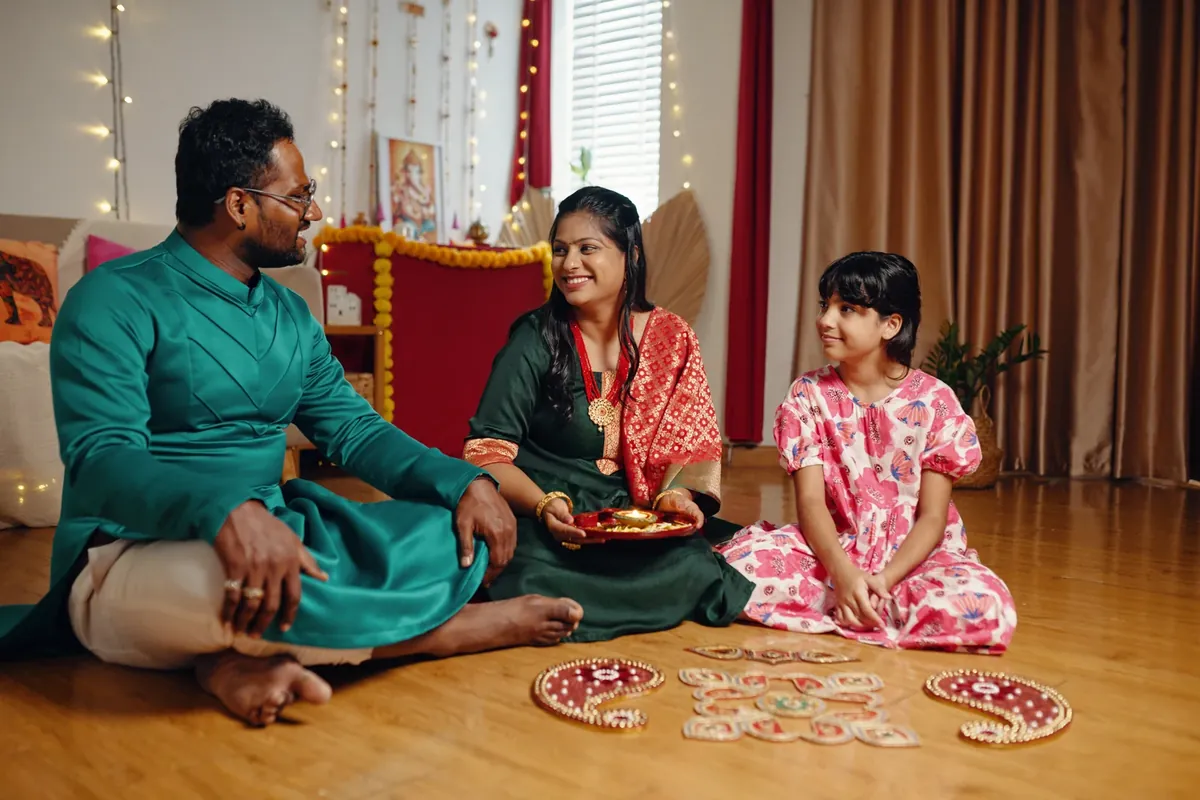
Start with a shape built from circles or a grid. They look good even when the lines are not perfect, and a stencil or a large plate will keep them tidy. Here are six, described in words so you can sketch them with chalk first.
Concentric circles with a diya in the centre
Draw a small circle, then two or three larger rings around it, spaced evenly. Fill alternate rings in different colours and set a diya in the middle. Use a plate as a guide for the first ring.
A lotus
Draw eight or twelve pointed petals around a small circle, then a second row of petals peeking out between the first. Pink and white petals with a yellow centre look right, and the lotus is closely associated with Lakshmi.
A dot-grid pattern
Place a grid of dots, five by five, and join them with curved lines that loop around each dot. In white rice flour this is the kolam way, and in colours it becomes a bold geometric design.
A pair of paisleys
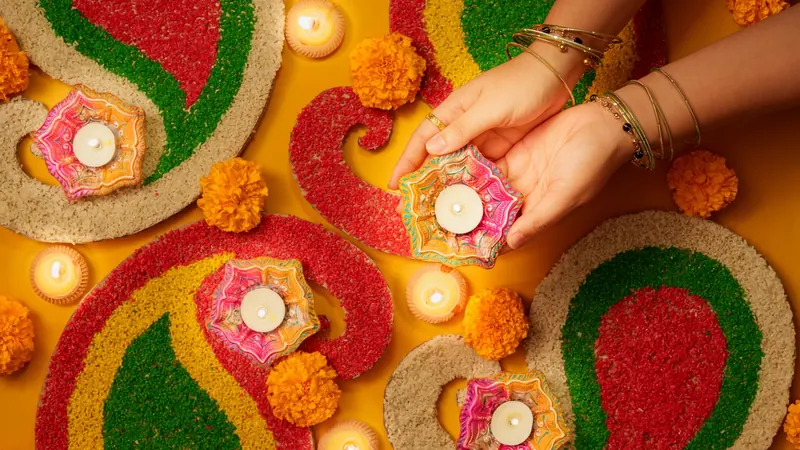
Draw two paisley shapes curling towards each other, like the ones in the photo at the top of this page. Fill each with bands of colour, working from the outside in, and add a few dots around the edge.
A diya border
Run a row of small diya shapes along the edge of the doorway, each with a flame in yellow and orange. It suits a narrow threshold where a round design will not fit.
A flower circle
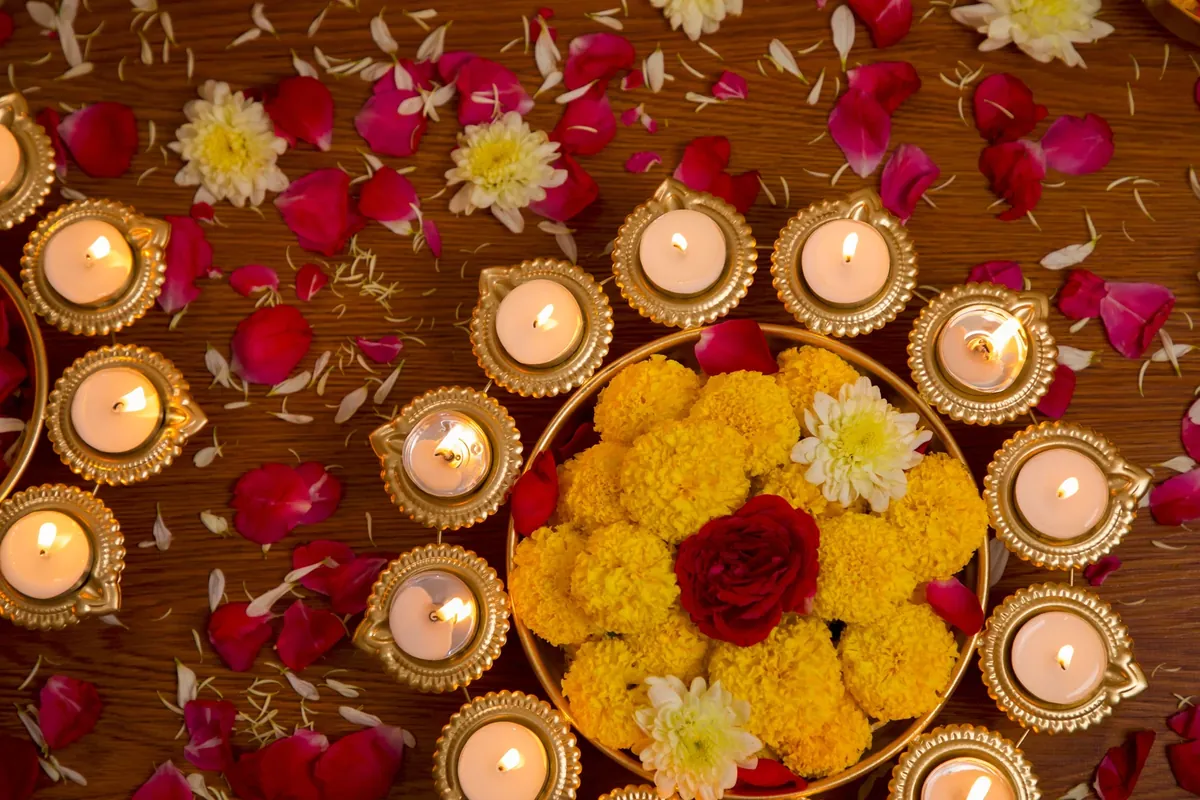
No drawing at all: a ring of marigold heads, a second ring of rose petals inside it, and one diya in the centre. It is the quickest design on this list.
Our picks: what to buy for Diwali rangoli
These are product types to search for, with what to check on each. Prices change daily, so check the current price on the listing.
A rangoli stencil set
The quickest route to a neat design. Measure your doorway first, and choose a size to match. Check that the sheet is flexible and the cut-out edges are clean, and that thin parts of the design will not tear.
Dry rangoli colour powder
Buy small packs from a maker that lists its ingredients, and read the section on colours below before you choose. Match the number of colours to the stencil, so you do not end up with a heap of leftovers.
A rangoli applicator or filler
A cone or roller-style tool lets you lay thin, even lines, so it helps with freehand designs and stencil work alike. Check that it is easy to refill and that the nozzle is not too wide.
A reusable rangoli sticker or ready-made piece
For rented flats and polished tiles. Check the size, whether the adhesive is reusable, and try it on a corner of the floor first, since adhesive can mark some surfaces.
An urli bowl for floating flowers
The small-space and windy-balcony answer. Check that it is wide enough for flowers and a tealight or two, that the material is what the listing says (brass, bronze or ceramic), and that the base is flat.
Artificial or dried flower petals
For a design you want to make a day ahead. Check that the colours do not bleed when damp, and keep dried flowers well away from any flame.
See ideas on Amazon.in
- A rangoli stencil setRangoli stencilsSee ideas
- Dry rangoli colour powderRangoli colour powderSee ideas
- A rangoli applicator or fillerRangoli applicatorsSee ideas
- A reusable rangoli sticker or ready-made pieceRangoli stickersSee ideas
- An urli bowl for floating flowersUrli bowlsSee ideas
- Artificial or dried flower petalsArtificial rangoli flowersSee ideas
Which colours are safe to use for rangoli?
The safest colours are the traditional ones: rice flour, turmeric and flower petals. For bright powders, buy from a maker that lists its ingredients, and treat a label such as "herbal" as a claim, not proof.
The nearest evidence we found is about Holi colours, not rangoli. A 2021 study (published online on 18 April 2021) of 200 dry samples from in and around Kolkata found lead and endotoxins, including in powders labelled herbal and non-toxic.
In a test reported in 2010, the Maharashtra Pollution Control Board found heavy metals in every colour it bought from Mumbai markets, herbal ones included. We found no equivalent published test of rangoli powders, so we cannot say they are the same, but the precaution is the same.
- Keep powders away from eyes and mouths, and wash hands after you finish.
- For young children, use petals or rice flour instead of powder.
- For yellow, rice coloured at home with turmeric is a safe, traditional choice.
- Skip glitter, or choose one labelled biodegradable. Most craft glitter is plastic, and the biodegradable claim is the maker's.
How do you make rangoli on a small balcony or in a flat?
Shrink the design and use a base you can lift. Rangoli does not need to be large to count, and a small, careful one looks better than a big messy one.
Try a quarter-circle in a corner, a border along the doorway, or a round design no wider than a large plate. Make it on a board or a big tray if you would like to carry it indoors when the weather turns.
Sketch it in chalk first, which on tiles usually wipes off with a damp cloth. If the corridor is shared, ask the society before you make anything outside your own door.
What if it rains or the wind picks up?
Choose a sheltered spot and heavier materials. Petals and coloured rice stay put better than fine powder, and a design made on a board can come indoors.
Fine powder blows away on a dry floor. A lightly damp, not wet, surface helps it stay, so try a small patch first. If rain is forecast, make an urli bowl or a sticker design instead.
How do you clean up rangoli afterwards?
Sweep first, then wipe. Sweep dry powder into a dustpan and bin it instead of washing it across the floor, which smears colour into the grout. Compost petals, peel stickers slowly from a corner, and clear any oil or wax from the diyas promptly so that no one slips.
What safety rules apply when diyas are part of the rangoli?
Never leave a lit diya unattended, and keep flames away from dry petals, paper stencils, curtains, dupattas, children and pets. Set diyas on a stable, non-combustible base, and put them out when you leave the house or go to bed.
If you add string lights near the door, switch off at the MCB before you touch a switchboard and keep plugs off wet floors. Our guide to Diwali lights and diya decoration ideas covers the electrical rules in full.
Frequently asked questions
What is the easiest Diwali rangoli for beginners?
A set of concentric circles with a diya in the middle, or a flower circle made of marigold heads and petals. Both look good without perfect lines, and a stencil makes the circles tidier.
Which colours are safe for rangoli?
The traditional ones are the safest: rice flour, turmeric and flower petals. For bright powders, buy from a maker that lists its ingredients, because "herbal" on a label does not guarantee safety. Keep powder away from eyes and mouths.
Can I make rangoli on tiles or in a flat?
Yes. Use a reusable sticker, a design on a tray or board, or an urli bowl of floating flowers. Try any adhesive on a small corner first, and sweep powder up rather than washing it into the grout.
How do I stop rangoli blowing away or washing out?
Choose a sheltered spot and heavier materials such as petals or coloured rice, make the design on a board you can carry in, or choose a sticker or bowl design when rain or wind is forecast.
Do I have to make rangoli at Diwali?
There is no single rule. Many families make rangoli at the entrance during Diwali to welcome Lakshmi, and customs differ by region and household. Follow your own family's way.
Your next step: measure your doorway today, pick one design from the list and one material, and sketch it on paper or in chalk before the day. For more ideas, see Diwali decoration ideas for home, Diwali lights and diya decoration ideas and the Diwali puja samagri list.
We may earn a commission if you buy through links on this page, at no extra cost to you. As an Amazon Associate I earn from qualifying purchases. How we earn