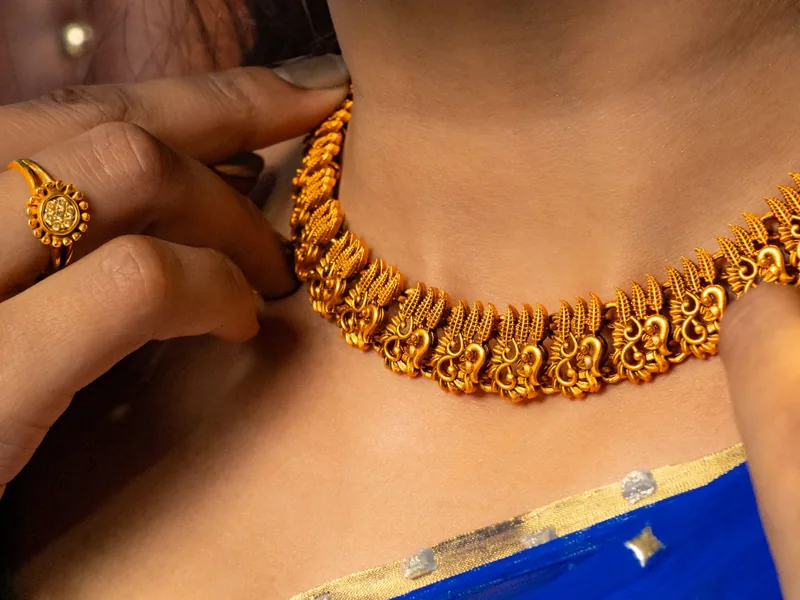
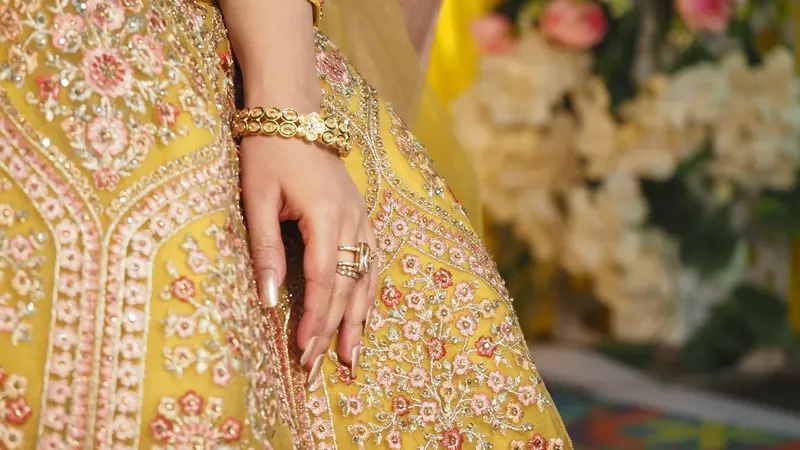
A gold bangles design falls into three practical bands: light (about 8 to 12 grams, for daily wear), medium (about 15 to 25 grams, for festivals and office-to-evening wear) and heavy (25 grams and above, for weddings and traditional kadas). Whatever the band, the price is net gold weight at the day's rate, plus the making charge, plus 3 percent GST on the whole bill.
The catch is that bangles are bought in sets, and the published weight guides rarely say whether a figure is per piece or per pair. Ask which before you compare anything. Every rupee figure below is an example, built on an example 22K rate of ₹13,500 per gram. It is not today's rate.
Which gold bangles design suits daily wear, and which suits occasions?
Shops use four words for bangles, and they are not interchangeable. BlueStone's kada guide (September 2026) describes them like this.
- Churi or kangan. Slender bangles, often worn several at a time. The natural choice for daily wear.
- Kada. Broader, heavier and rigid, worn alone or as a frame for lighter bangles. Widths run from about 6 mm to over 25 mm.
- Openable kada. A hinged design, often oval, that clasps round the wrist instead of sliding over the knuckles.
- Closed slip-on bangle. No hinge, so it must clear the widest part of your hand.
The weight bands come from BlueStone's women's bangle guide (November 2025). We have grouped its figures into three, and they are indicative, not a rule.
| Band | Weight in that guide | Where it fits |
|---|---|---|
| Light | 8 to 12 grams for simple styles | Daily wear, office, college |
| Medium | 15 to 25 grams | Festivals, family functions, slightly dressy days |
| Heavy | 25 to 40 grams or more for traditional kadas | Weddings and traditional occasions |
Our stance: for daily wear, choose slim, plain, hallmarked bangles you can forget about. Keep the heavy handwork for the days it will be seen and photographed.
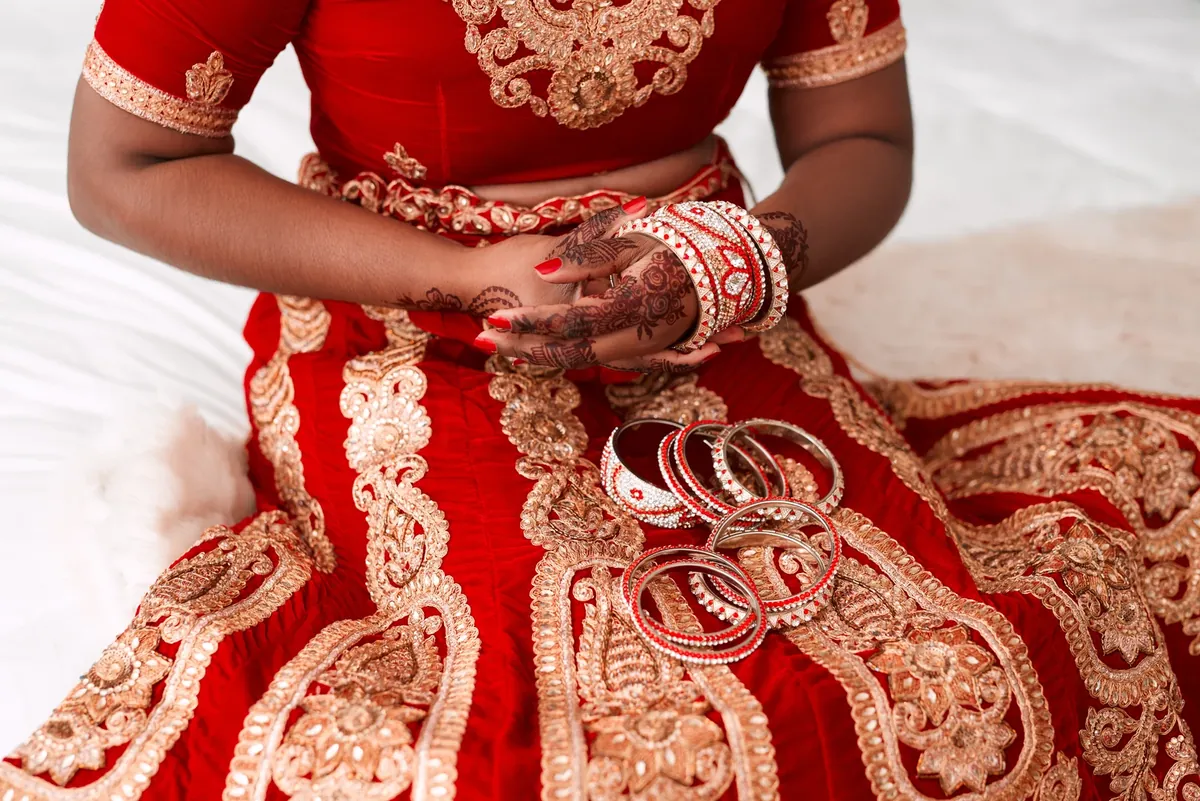
Machine-made, handmade or hollow: what are you paying for?
Machine-made. Plain bangles are often machine-formed in fixed sizes, which keeps the making charge lower. IIFL's guide (15 July 2026) puts bangles at 6 to 10 percent of gold value.
Handmade. Carved, filigree and temple work take skilled hours, and the price shows it. IIFL puts kadas at 10 to 16 percent, rising to about 18 percent for carved or engraved designs. That is fair when the design is what you are buying.
Hollow. A hollow bangle is a thin gold shell, and a hollow or lac-filled kada can look heavier than the gold in it. Ask for the net gold weight, and ask whether the piece is hollow, lac-filled or solid.
As an illustration only, at the example rate an 18 gram hollow kada holds ₹2,43,000 of gold, against ₹5,40,000 for a solid 40 gram one. That saves ₹2,97,000 in gold, but a thin shell dents more easily, and when you sell, you are paid only for the gold actually in it.
In a lac-filled piece the resin wax adds weight that is not gold, so the invoice should separate gross weight, non-gold deductions and net gold weight, and the gold rate should apply to the net gold only.
22K or 18K for gold bangles?
22K is 91.6 percent gold (22K916) and 18K is 75 percent (18K750). BlueStone's kada guide notes that 22K is naturally soft, so kadas in it need substantial wall thickness, and calls 18K the usual recommendation for daily-wear kadas. Tyaani's guide likewise describes 18K as more resistant to scratches and bending.
Bangles knock against desks, door frames and steering wheels all day. A thin 22K bangle can bend or lose its shape with that treatment, so for daily wear either choose 18K or a slightly thicker 22K. For weddings and heirloom pieces, 22K is what many families expect.
Do not assume 18K is cheaper overall. It has about 18 percent less gold per gram than 22K (75 divided by 91.6), but Aditya Birla Capital lists 18 carat making charges at ₹400 to ₹800 per gram, against ₹150 to ₹500 for 22 carat. Compare the totals. Our 22K vs 24K guide covers the purity maths.
What do light, medium and heavy gold bangles cost?
Aditya Birla Capital's per-gram guide (posted 22 May 2026, updated 12 October 2026) lists plain gold bangles at ₹200 to ₹350 per gram, with handcrafted bangles costing more. The table uses that band for the light and medium sets and a 10 percent making charge, the bottom of IIFL's kada range, for the heavy hand-finished kada. All figures are examples.
| Example | Light set | Medium set | Heavy kada |
|---|---|---|---|
| Net gold weight | 10 g | 20 g | 40 g |
| Gold value at ₹13,500 per gram | ₹1,35,000 | ₹2,70,000 | ₹5,40,000 |
| Making charge (example) | ₹300 per gram, ₹3,000 | ₹350 per gram, ₹7,000 | 10 percent, ₹54,000 |
| Subtotal | ₹1,38,000 | ₹2,77,000 | ₹5,94,000 |
| GST at 3 percent | ₹4,140 | ₹8,310 | ₹17,820 |
| Example total | ₹1,42,140 | ₹2,85,310 | ₹6,11,820 |
| Making as a share of the subtotal | about 2.2 percent | about 2.5 percent | about 9.1 percent |
Allow for the hallmarking fee too: BIS raised the gold hallmarking fee to ₹75 per article plus taxes in September 2026 (some BIS pages still show the older ₹45); the jeweller pays it, so ask for it as its own line, and check the current fee.
The pattern matters more than any single number. On plain, light bangles the gold is about 98 percent of the pre-GST price, so the gold rate and the grams decide your bill. On a heavy, hand-finished kada, labour is about a tenth of it, so a discount on the making charge is worth real money.
These are not shop quotes. Published guides vary, so ask each shop for its own per-gram or percentage figure and compare the final totals. Our gold chain guide shows the same comparison method for a chain.
How do you get the bangle size right?
A closed bangle has to clear the widest part of your hand. Bring your fingers together, move the thumb towards the little finger, wrap a flexible tape or thread round the widest part of the knuckles, and take the reading three times.
Use the largest consistent figure. If you fall between two sizes on a rigid closed bangle, BlueStone's size guide (August 2026) suggests choosing the next larger one. Check bangle size gauges on Amazon
| Indian size (BlueStone chart) | Inner diameter |
|---|---|
| 2-4 | 57.2 mm |
| 2-6 | 60.3 mm |
| 2-8 | 63.5 mm |
| 2-10 | 66.7 mm |
Labels differ between shops, and many charts write the same sizes as 2.4, 2.6 and so on, so compare the millimetre figure and not the label. For a hinged kada, BlueStone advises measuring the wrist just above the wrist bone and adding 1.5 to 2.0 cm of comfort ease. For a solid slip-on kada, divide the knuckle circumference by 3.14159 to get the inner diameter you need.
Stones, wastage and the lines on the invoice
If a bangle has stones, pearls, enamel or a lac core, the bill should show gross weight, the weight of everything that is not gold, and the net gold weight. You should pay the gold rate only on the net gold, and the stones are charged separately.
Ask whether the making charge is calculated on net or gross weight, because a charge on gross weight means paying a making charge on the stones as well.
Some shops also add wastage, a charge for the small amount of metal lost while a piece is worked, as a separate line. Others fold it into the making charge. Either can be fair. Add every line and compare the grand total, and see our gold making charges guide for how to read it.
Hallmark, HUID and resale: what to check before you pay
Each hallmarked piece carries the BIS logo, the purity mark (22K916 or 18K750) and a six-character alphanumeric HUID. Check every bangle in a set, not just one, and verify the HUID with the Verify HUID option in the BIS Care app. BIS publishes the rules at bis.gov.in, and our HUID and hallmark guide walks through the app.
Mandatory hallmarking applies in the districts BIS has notified: 380 from 2 March 2026, extended by later orders (a Third Amendment Order of 3 August 2026 took coverage to 392 districts, according to Business Standard), so check the current BIS list for your district.
Exemptions cover jewellers with turnover up to ₹40 lakh, pieces under 2 grams, and Kundan, Polki and Jadau jewellery. So a heavy kundan or polki bangle may legally carry no hallmark. In that case ask for a purity certificate or a test report.
If a hallmarked piece fails a purity test, BIS says the buyer is entitled to two times the money value of the shortfall in purity for the weight sold, plus the testing charges.
On resale, jewellers generally value old gold on the pure gold in it at that day's rate. Making charges and GST are generally not returned, a hollow bangle is valued on the gold actually inside, and stones and lac are generally not valued as gold. So ask before you buy:
- Do you buy this back, or only exchange it?
- What deduction applies, and is it the same if I bought it elsewhere?
- How do you value stones on a stone-set bangle?
- Do I need the original invoice and the hallmark details?
Once the invoice is in your bag, a bangle organiser keeps sets from scratching one another. Check bangle boxes and organisers on Amazon
Frequently asked questions
How many grams is a light gold bangle?
One jeweller's published guide puts daily-wear bangles at about 8 to 12 grams for simple styles. There is no official definition, and the guide does not say whether that is per piece or per pair, so ask the shop which weight it is quoting.
Are hollow gold bangles worth buying?
They put less gold into the same look, which lowers the price, but a thin shell dents more easily and is valued on its gold content when you sell. Ask for the net gold weight and whether the piece is hollow, lac-filled or solid, and do not pay a solid bangle's making charge for a hollow one.
What making charge should I pay on gold bangles?
There is no official rate. Aditya Birla Capital lists plain bangles at ₹200 to ₹350 per gram, and IIFL gives 6 to 10 percent for bangles and 10 to 16 percent for kadas. Ask for each shop's figure and compare final totals.
Does every gold bangle need a HUID?
Where mandatory hallmarking applies, yes, but jewellers with turnover up to ₹40 lakh, pieces under 2 grams and Kundan, Polki and Jadau jewellery are exempt. Check each bangle for the BIS logo, purity mark and six-character HUID, and verify the code in the BIS Care app.
Can I sell gold bangles back at the price I paid?
No. You generally get the day's rate for the pure gold in them, less any deduction. Making charges and GST are generally not returned, so read the buyback terms before you buy.
Your next step: choose a band, then get a written quote from two shops with net weight, rate, making charge and total. Check the arithmetic with our gold price calculation guide, read what to pay in making charges, and see what to buy, rent or skip in a bridal jewellery set if the bangles are for a wedding.
We may earn a commission if you buy through links on this page, at no extra cost to you. As an Amazon Associate I earn from qualifying purchases. How we earn