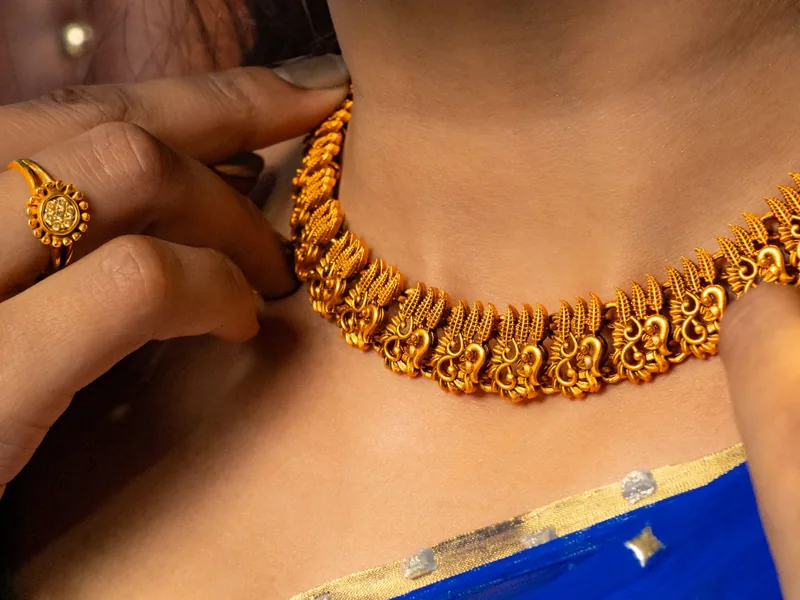
The price of gold jewellery in India is the net gold weight multiplied by that day's rate for the purity, plus the making charge, plus any wastage and stone value, plus GST. In short: (net weight x rate) + making + wastage + stones, then GST on top. Below is a worked example with example numbers and a checklist for reading any jeweller's bill.
On 14 October 2026 IBJA's 22K (916) benchmark on ibjarates.com was about ₹13,522 per gram, before GST and making charges. The calculator below starts with a placeholder rate near that figure, so replace it with today's. In the worked examples in the text we use a round example rate of ₹13,500 per gram for 22K so the arithmetic is easy to follow. Always check the rate yourself on the day you buy, because gold moves daily.
Try it with real numbers: type the weight, the day's rate and each shop's making charge, and the calculator does this sum for you.
What is the formula for the price of gold jewellery?
Write it down once and you can check any quote:
- Gold value = net gold weight in grams x rate per gram for that purity
- Add the making charge (a percentage of gold value, a rate per gram, or a flat amount). A percentage is usually quoted on the gold value; shops differ on whether wastage is included, so ask which base yours uses
- Add wastage, if the shop charges it separately
- Add the stone value, if there are diamonds or gemstones
- Add GST on the total, as shown on the invoice
The word that matters most is "net". The weight on the tag may include stones, enamel or other non-gold parts. You pay the gold rate only on the gold itself.
The second thing to pin down is the base for the making charge. This guide and the calculator take a percentage making charge on the gold value (net weight x rate), before wastage is added. Some shops take it on gold plus wastage, or on gross weight, which costs you more. The sum looks the same, but the base is the shop's decision, so ask.
Where do you get the day's gold rate?
Gold rates change through the day. A published benchmark is the best reference point, so you know whether a jeweller's rate is in the right region. The India Bullion and Jewellers Association (IBJA) publishes daily benchmark rates for gold at 999, 995, 916, 750 and 585 purity at ibjarates.com, and its own page states that these rates are without 3 percent GST and making charges.
Three cautions apply when you read any rate:
- Check the unit. Some sources show a price per gram and others per 10 grams. Mixing them up changes your total tenfold, so confirm it before you do any sums.
- Check the purity. The rate for 24K (999) is higher than the rate for 22K (916). Use the rate that matches your piece.
- A jeweller's own rate can differ a little from the benchmark, and rates move during the day. A large gap is worth a question, not a quarrel.
Which purity rate do you use?
Under the Bureau of Indian Standards (BIS) rules, gold jewellery is hallmarked in 14, 18, 20, 22, 23 and 24 carat grades, and the purity mark shows the carat and the fineness. These are the common ones:
| Carat | Fineness (purity mark) | Pure gold share |
|---|---|---|
| 24K | 999 (some marks read 995) | About 99.9 percent |
| 23K | 958 | About 95.8 percent |
| 22K | 916 | About 91.6 percent |
| 20K | 833 | About 83.3 percent |
| 18K | 750 | 75 percent |
| 14K | 585 | About 58.5 percent |
Most Indian jewellery is 22K, so a jeweller will usually quote you a 22K rate. If you only have the 24K rate, you can estimate the 22K rate by multiplying it by 22 and dividing by 24. For example, if the 24K rate were ₹14,700 per gram (an example), the 22K rate would be about ₹13,500 per gram.
Jewellers often publish their own 22K rate, so use theirs for the final bill, and use this shortcut only as a sense-check.
What does a full worked example look like?
Take a 22K necklace and an example rate of ₹13,500 per gram, close to the IBJA figure above. These are example numbers, not a quote.
- Net gold weight: 10 grams
- 22K rate (example): ₹13,500 per gram
- Making charge: 10 percent of the gold value
- No wastage charged separately and no stones
| Step | Working | Amount |
|---|---|---|
| Gold value | 10 g x ₹13,500 | ₹1,35,000 |
| Making charge | 10 percent of ₹1,35,000 | ₹13,500 |
| Total before GST | ₹1,35,000 + ₹13,500 | ₹1,48,500 |
| GST on finished jewellery | 3 percent of ₹1,48,500 | ₹4,455 |
| Final price | ₹1,48,500 + ₹4,455 | ₹1,52,955 |
The bigger lever in the bill is the making charge, which is ₹13,500 here. If a different shop quoted 14 percent making on the same piece, the making charge alone would be ₹18,900, which is ₹5,400 more before GST.
Notice that the 10 percent is taken on the gold value of ₹1,35,000, the same way the calculator does it. A shop that takes its 10 percent on a higher base, such as gold plus wastage, will show a larger making charge for the same necklace, so ask which base your shop uses.
How do you handle stones and gross versus net weight?
Suppose an 18K pendant has a gross weight of 12 grams on the tag, and the jeweller states 2 grams of that is stones. Net gold weight is 10 grams. You pay the gold rate on 10 grams, not 12. The 18K rate below, about ₹11,000 per gram, is an example. The stones are priced separately, for instance ₹8,000, and then added.
| Line | Working | Amount |
|---|---|---|
| Gold | 10 g x ₹11,000 (18K, example rate) | ₹1,10,000 |
| Making charge at 12 percent | 12 percent of ₹1,10,000 | ₹13,200 |
| Stones | As quoted | ₹8,000 |
| Total before GST | ₹1,31,200 |
If you were charged the gold rate on the full 12 grams, you would pay for an extra 2 grams, or ₹22,000 at the rate. Always ask for gross weight, stone weight and net weight to appear separately on the invoice. Also check whether the making charge is on net weight or gross weight; a charge on gross weight costs more.
How does GST fit in?
For finished jewellery, GST is 3 percent on the whole bill, making charges included. The CBIC's FAQ on gems and jewellery says GST is payable at 3 percent of the total value of the jewellery, whether or not the making charge is shown separately.
If you bring your own gold, GST is extra on the making charge: ask the goldsmith for the rate and get it on the bill. For a finished piece, multiply the total by 1.03 to get the invoice price, and if a shop adds a separate 5 percent on the making charge, ask to see how the invoice was worked out.
What about wastage and hallmarking fees?
Some shops add a wastage charge, sometimes shown as extra weight. We found no official rate for it, so treat any figure as the shop's own price, add it as a separate line in your sum and ask whether the making charge already includes it.
Hallmarking itself is a small cost: BIS raised the gold hallmarking fee to ₹75 per article plus taxes in September 2026 (BIS's own FAQ page still shows an older fee), paid by the jeweller to the assaying centre; check the current fee. The fee does not include making or wastage charges.
Here is the effect of an example wastage of 5 percent on the 10 gram necklace. You are billed for 10.5 grams of gold, so wastage adds 0.5 g x ₹13,500 = ₹6,750 as its own line. Worked the calculator's way, the 10 percent making charge stays at ₹13,500, because it is taken on the gold value of ₹1,35,000 before wastage.
Some shops instead take the 10 percent on the wastage-inclusive value of ₹1,41,750, which makes the making charge ₹14,175, or ₹675 more. Same necklace, same percentage, different base: that is why you ask.
What should you check before you buy?
When you have the quote, check these points against the formula.
- BIS hallmark and HUID. Where hallmarking applies, the piece should carry the BIS logo, the purity mark such as 22K916 and the six-character alphanumeric HUID, which has been compulsory on hallmarked jewellery sold since 1 April 2023. Mandatory hallmarking covers the districts BIS has notified: 380 from 2 March 2026, extended by later orders (a Third Amendment Order of 3 August 2026 took it to 392 districts, according to Business Standard), so check the current BIS list for your district. BIS lists exemptions: jewellers with turnover up to ₹40 lakh a year, pieces under 2 grams, and Kundan, Polki and Jadau jewellery. Use the Verify HUID option in the BIS Care app, and see bis.gov.in for the standard.
- Net weight and stone weight. Listed on the invoice, not just the tag.
- The rate and the unit. Per gram or per 10 grams, for the correct purity, compared with a published benchmark.
- Making charge. Percentage, per gram or flat, and on net or gross weight.
- GST lines. Which rate applies to which part.
- Buyback terms. Jewellers generally value old gold on the net pure gold in it at that day's rate, and making charges and GST are not returned.
- An itemised invoice. Keep it safe along with any hallmark paperwork.
Our gold making charges guide goes deeper on what is a fair charge for different kinds of jewellery.

Can you do this sum on your phone in the shop?
Yes, and it is worth doing. Open the calculator, and type the net weight times the per gram rate for the purity. Then add the making charge as a rupee figure and any stone value. Multiply the total by 1.03 for a quick estimate with 3 percent GST on everything.
That will match the invoice of a finished piece closely, so a gap of several thousand rupees means something else is going on and deserves a question.
A good jeweller will not mind you doing this. If the answer to "How did you get this number?" is vague, that is useful information too.
Should you buy during Dhanteras or wedding season?
Many families buy gold around Dhanteras, which falls on Friday 6 November in 2026 according to most calendars (please check your local panchang), and during wedding season. Demand is high then, queues are long and it is easy to rush the sums. Do the calculation at home beforehand, and use our Dhanteras 2026 guide to decide what is worth buying.
Related: how to check the HUID and hallmark, the gold jewellery buying guide, gold making charges in India and jewellery brands compared.
Frequently asked questions
How do I calculate the price of 22K gold jewellery?
Multiply the net gold weight in grams by the day's 22K rate per gram, add the making charge and any wastage and stone value, then add GST. Use net weight, not the gross weight on the tag.
Where can I check the daily gold rate in India?
The India Bullion and Jewellers Association publishes benchmark rates at ibjarates.com, without GST and making charges. Your jeweller's own rate may differ a little, and rates change through the day.
What is the difference between gross weight and net weight?
Gross weight includes everything on the piece, such as stones. Net weight is the gold alone. You should pay the gold rate only on the net weight, and stones are priced separately.
How much GST is charged on gold jewellery?
For finished jewellery, GST is 3 percent on the whole bill, making charges included. If you bring your own gold, GST is extra on the making charge: ask the goldsmith for the rate and get it on the bill..
Can I estimate the 22K rate from the 24K rate?
Roughly. Multiply the 24K rate by 22 and divide by 24 for an estimate, since 22K is about 91.6 percent gold. Use your jeweller's quoted 22K rate for the actual bill.
Your next step is to take any quote you have received, write each line of the formula against it and see which one is not explained. For the purity side of the decision, read our 22K vs 24K gold comparison, and see our gold earrings for daily use guide if you are starting with something small.
We may earn a commission if you buy through links on this page, at no extra cost to you. As an Amazon Associate I earn from qualifying purchases. How we earn