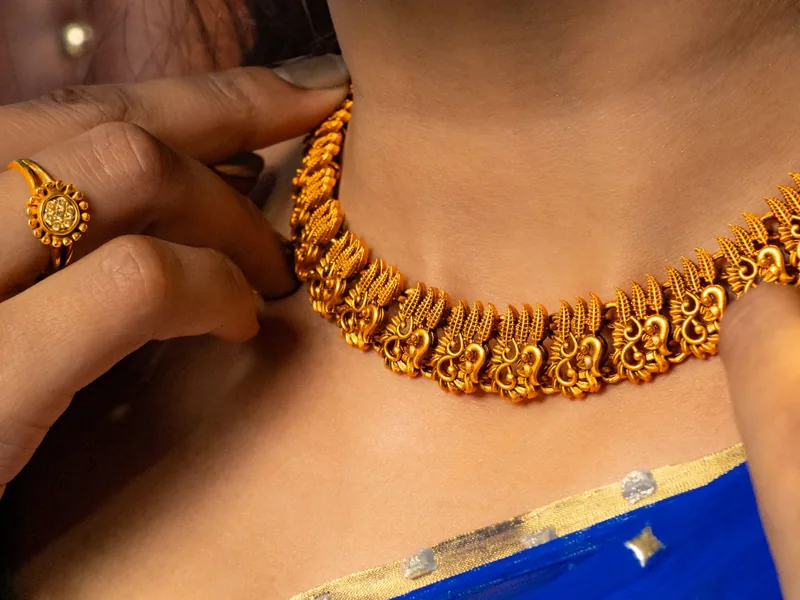
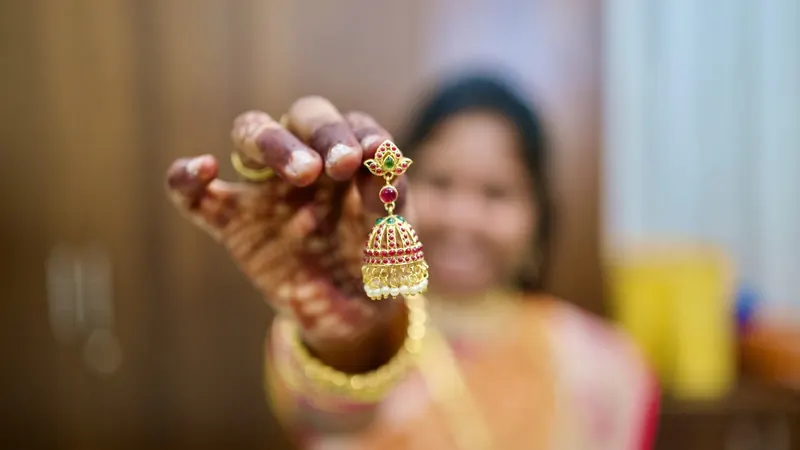
For daily wear, choose small studs, huggie hoops, short ear chains or compact jhumkas, usually 1 to 4 grams a pair. At an example ₹13,500 a gram for 22K, with making at ₹400 a gram and 3 percent GST, 1.2 g studs come to about ₹17,000 and a 4 g jhumka pair about ₹57,000.
Which gold earring designs suit daily wear?
Daily earrings need to pass four tests. They should be light enough that you forget them, smooth enough not to snag hair or a dupatta, secure enough that you do not lose one in a bus queue, and plain enough to go with both a cotton kurta and an office shirt.
Studs (tops)
A round, floral or tiny geometric stud sits flat against the lobe, so it does not catch on anything. Buy studs with a screw back or a locking push back. The back is what fails, so ask to see it and check it holds under a gentle tug. A stud is also the lowest-risk first purchase if you have not bought gold for yourself before.
Huggie hoops and small bali
Thin hoops that hug the lobe are light and look current. Check that the closing mechanism clicks firmly. A hoop that is too thin can bend if you sleep on it, so ask the jeweller about wire thickness rather than judging by looks alone.
Ear chains and short drops
A short chain or a tiny drop gives movement without the weight of a full jhumka. These work well with sarees and with Indo-western looks. Because a chain has many small links, ask for the net gold weight rather than assuming it is as light as it looks.
Compact jhumkas
The classic bell shape in a small size is comfortable for a full day. Large temple jhumkas are lovely for weddings but heavy on the ear, so keep them for occasions.
Sleepers and plain rings
Plain gold sleepers and thin rings are the lowest-maintenance option for people who rarely take earrings off. They still need a regular clean around the closing, because soap and sweat collect there.
How much gold weight counts as lightweight?
There is no official line for "lightweight", but two numbers matter: under 2 g per article is exempt from mandatory hallmarking (ask the shop whether it counts a pair as one article), and each extra gram adds about ₹14,300 at the example rate, so a 2 g pair is about ₹28,600 and a 3 g pair about ₹43,000.
What matters is that the weight on the invoice (the net gold weight, after any stones are subtracted) is the figure you compare between shops. A pair that looks bigger but is hollow or made of thin wire can weigh less than a small solid stud, and the price follows the grams, not the size.
The example weights used in the table below, from 1.2 grams for tiny studs to 4 grams for a compact jhumka pair, are illustrative numbers chosen so the sums are easy to follow. They are not a catalogue. Your real pair will carry whatever weight the jeweller's scale shows.
Two practical notes. First, if the pair is studded with stones or pearls, the invoice should show gross weight, stone weight and net gold weight as separate lines, and you should be charged the gold rate only on the net gold.
Second, if a design is hollow, ask what it is filled with and whether the jeweller will repair it in future. That is a fair question and a good jeweller will answer it plainly.
22K or 18K for everyday earrings?
The number is the share of pure gold in 24 parts. 22K is 22 parts gold, about 91.6% pure. 18K is 18 parts gold, 75% pure, with the rest being other metals. Both are covered by the BIS hallmarking system, which lists 14, 18, 20, 22, 23 and 24 carat as the mandatory grades.
The trade-off is simple. 22K has more gold, so each gram costs more (about ₹13,500 against about ₹11,000 for 18K, at the example rates used on this page) and it is slightly softer. 18K costs less per gram and is a common choice for lighter, finer or stone-set designs.
If you plan to sell or exchange the earrings later, 22K is the grade many families think of as the traditional store of value, but the right answer depends on the design and your budget. Our guide to 22K vs 24K gold explains the purity maths in more detail.
What do gold earrings for daily use cost?
The formula is gold value plus making charges plus 3% GST. The table uses an example gold rate of ₹13,500 per gram for 22K, close to the IBJA benchmark in the week of 12 October 2026, and an example making charge of ₹400 per gram, which sits inside the ₹200 to ₹600 per gram range published by Aditya Birla Capital. These are example numbers, not today's rate. Look up the current rate on the day you buy and swap it in.
| Design (example) | Net gold weight | Gold value | Making at ₹400 per gram | GST at 3% | Example total |
|---|---|---|---|---|---|
| Tiny studs | 1.2 g | ₹16,200 | ₹480 | ₹500 | ₹17,180 |
| Small hoops | 2.5 g | ₹33,750 | ₹1,000 | ₹1,043 | ₹35,793 |
| Ear chains or drops | 3.0 g | ₹40,500 | ₹1,200 | ₹1,251 | ₹42,951 |
| Compact jhumkas | 4.0 g | ₹54,000 | ₹1,600 | ₹1,668 | ₹57,268 |
Notice what moves the total most: the gold rate and the grams, not the making charge. At these example numbers, making charges are only about 3% of the gold value. That changes quickly if a shop quotes a percentage instead, as the next section shows.
Making charges: per gram or percentage?
Jewellers quote making charges in two ways, and it is easy to compare the wrong pair of numbers. Some charge a fixed rupee amount per gram. Others charge a percentage of the gold value. Aditya Birla Capital's guide notes that both methods are used, and that charges sit on top of the gold rate and GST is added as well.
Take the 3 gram pair from the table. At ₹400 per gram, making is ₹1,200. If another shop quotes 12% on the same ₹40,500 of gold, making becomes ₹4,860. After 3% GST the two bills are ₹42,951 and ₹46,721, a gap of ₹3,770 for the same grams.
Neither quote is wrong, but they cannot be compared until both are in rupees per gram: 12 percent of ₹13,500 is ₹1,620 a gram, four times the ₹400 quote.
A tiny stud can cost more per gram to make than a plain bangle, because the work does not shrink as fast as the weight does. So a higher per-gram quote on a very light pair is not unusual. We go through the whole topic in gold making charges in India, and the full price formula is in how to calculate gold price in India.
On GST: the GST Council's FAQ for the gems and jewellery sector says GST is payable at 3% of the total transaction value of jewellery, whether or not the making charge is shown separately. The 5% rate you may see online applies to job work between a jeweller and a manufacturer, not to your retail bill.
If a bill adds 5% on top of making charges, ask the shop to explain it in writing.
Hallmark checks for small earrings
This is the part most buyers skip, and for earrings it matters because the pieces are small. Under the BIS system, hallmarked gold jewellery carries three marks: the BIS mark, a purity mark such as 22K916, and a six-character alphanumeric HUID that is unique to each piece. BIS also says buyers can check a HUID in the BIS Care app.
Now the catch. Mandatory hallmarking applies in the districts BIS has notified: 380 from 2 March 2026, extended by later orders (a Third Amendment Order of 3 August 2026 took it to 392 districts, according to Business Standard), so check the current BIS list for your district.
BIS lists exemptions, including jewellery weighing under two grams, jewellers with annual turnover up to ₹40 lakh, and Kundan, Polki and Jadau pieces. A jeweller may still choose to hallmark such items. In practice, a very light stud may legally carry no HUID, and so may a pair bought in a district the rule does not yet cover.
It is not a sign of anything wrong, but it means you rely more on the invoice and the shop's reputation.
So do three things at the counter:
- Ask for the carat and purity to be written on the invoice. BIS's consumer FAQ says the bill for a hallmarked article should show the item description, net weight, carat and fineness, and the hallmarking charge.
- Ask whether each earring carries a HUID. If one does, verify it in the BIS Care app before you pay.
- Keep the invoice. Exchange and buyback terms at most shops ask for it.
Our picks: what to buy for daily wear
These are product types to shop for, not specific designs. For gold, we link to the home pages of well-known sellers so you can browse their earring ranges and read their current terms. For lightweight imitation and anti-tarnish pieces, we link to Amazon searches. Always check the current price, material description and return terms before you order.
Small gold studs for every day
The safe default. Look for a screw or lock back, a flat profile and a clearly stated net weight. Browse gold earring styles at CaratLane.
Light gold hoops or huggies
Good for office and travel. Check the clasp and ask about wire thickness. Browse gold hoops at BlueStone.
Plain gold sleepers or bali
Low maintenance and easy to sleep in. Confirm the carat and the invoice weight. Browse gold earrings at Tanishq.
Lightweight jhumkas for occasions
A compact gold-look jhumka gives you the festive look for Navratri or a family function without the weight or cost. Check the material (brass, alloy or plated) and the back closure..
Anti-tarnish studs as a back-up pair
Useful for the gym, travel or days you do not want to risk real gold. Read whether the finish is plated, PVD coated or stainless steel, and whether the listing says nickel free..
Gold-tone hoops for a trial run
If you are unsure about hoops, a low-cost gold-tone pair tells you whether you like the size and feel before you spend on real gold..
See ideas on Amazon.in

Imitation and anti-tarnish earrings: how to read the listing
Gold-plated, gold-tone and imitation earrings are not hallmarked gold, and they do not come with a HUID. They are priced as fashion accessories, so judge them as that. A few things separate a pair that lasts from one that turns your lobe green:
- Base metal. Stainless steel and sterling silver bases generally cope better with sweat than a plain brass or alloy base. The listing should name the base metal.
- Finish. Words such as "anti-tarnish" describe a marketing claim. Look for what the coating actually is and how thick it is, then read customer reviews that mention wear after a few weeks.
- Skin sensitivity. If your ears react to cheap jewellery, look for "nickel free" in the description and keep real gold or surgical steel for daily wear. If a reaction persists, check with a doctor.
- Return window. Earrings are often non-returnable on hygiene grounds, so read the return terms before you buy.
Caring for daily-wear gold earrings
Gold does not rust, but everyday life still dulls it. Put earrings on after perfume, hairspray and moisturiser, not before. Take them out for heavy workouts and for sleeping if the design has a drop or hook. Wipe them with a soft dry cloth, and wash occasionally in lukewarm water with a drop of mild soap, then dry fully.
Store each pair in its own pouch so hard pieces do not scratch softer ones.
Check the back closure every few weeks. A loose back is a common way to lose an earring. Some jewellers will tighten or replace a worn back for little or nothing, so ask.
A five-minute checklist before you pay
- Ask for the net gold weight in grams, and check that it is on the invoice.
- Ask for the day's gold rate for the carat you chose, and compare it with a published rate for your city.
- Ask for the making charge in both forms (per gram and percentage) and compare shops in the same unit.
- Confirm 3% GST on the total, not 3% plus an extra 5%.
- Ask about the HUID, and for pieces under two grams, ask for the carat in writing.
- Ask what the exchange and buyback terms are, and whether they return making charges and GST, or only the gold value.
Can you buy real gold earrings under ₹10,000?
At ₹13,500 a gram, ₹10,000 buys about 0.7 g after making charges and GST. A piece under 2 g is exempt from mandatory hallmarking, so get the carat in writing. BIS also has a voluntary 9K grade, which is cheaper per gram but outside mandatory hallmarking.
Next steps: how to check the HUID and hallmark, gold chains by weight and price, gold bangle designs and Karwa Chauth gift ideas for a wife.
Frequently asked questions
How many grams should daily-wear gold earrings be?
There is no rule, but small studs and thin hoops are usually the lightest options, and a compact jhumka pair is heavier. Compare the net gold weight on the invoice rather than judging by size, because the price follows the grams.
Do gold earrings under 2 grams need a hallmark?
Not necessarily. BIS lists jewellery weighing under 2 grams among the items exempt from mandatory hallmarking, along with jewellers with annual turnover up to ₹40 lakh and Kundan, Polki and Jadau pieces, and the scheme applies only in notified districts. A jeweller may still hallmark such items. Ask for the carat and purity in writing on the invoice either way.
How much GST do I pay on gold earrings?
The GST Council's FAQ for the sector says 3% of the total transaction value of jewellery, whether or not the making charge is shown separately. The 5% rate applies to job work between businesses, not to your retail bill. Check the rate on your own invoice.
Is 18K or 22K better for daily wear?
22K is about 91.6% pure gold and slightly softer, while 18K is 75% pure and is commonly used for lighter or stone-set designs. Both can be hallmarked. Pick based on design, budget and how you plan to use the piece.
Can I wear gold-plated or anti-tarnish earrings every day?
You can, but plating wears off at a rate that depends on the base metal and your skin. Check the listing for the base metal and a nickel free claim, and keep a pair of real gold or surgical steel for days when you want zero risk.
Your next step: pick one design from the list above, then ask two shops to quote the same pair in grams, making per gram and the final bill including GST. If you are buying around the festival season, read Dhanteras 2026: what to buy and what to skip, and compare brands on the checks in our brand checklist for jewellery in India.
We may earn a commission if you buy through links on this page, at no extra cost to you. As an Amazon Associate I earn from qualifying purchases. How we earn