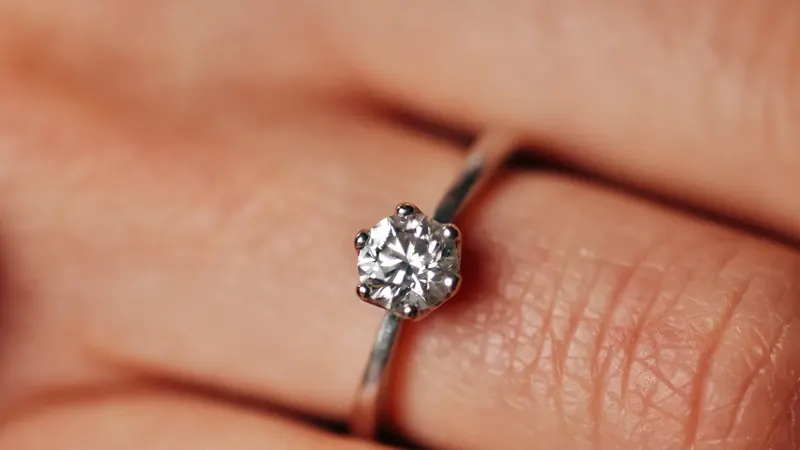
Buy a laboratory-grown diamond if you want the biggest, best-looking stone for your budget and are wearing it for love rather than as a store of value. Buy a natural diamond if rarity, tradition or a better chance of resale matter more to you than size per rupee.
The two are the same material, and the price gap in India is large: retailers publish prices for a 1 carat laboratory-grown stone that are a fraction of a natural stone of the same grade.
A note on the words, because India now has a standard for them. This guide says "laboratory-grown diamond" throughout, the term the standard uses. "Lab-grown" is the phrase most people type into a search box, which is why it appears here once; the JK Diamonds Institute and Jewellery Net Asia report that it, along with "lab-created", "lab diamond" and "LGD", is no longer permitted on labels and certificates.
What India's labelling standard says. The Bureau of Indian Standards adopted IS 19469:2025 in January 2026, a modified adoption of the international standard ISO 18323:2015. As reported by Indian Jeweller, it reserves the word "diamond" on its own for natural stones, and a stone grown in a laboratory must be described as a "laboratory-grown diamond" or a "laboratory-created diamond", with that disclosure given clearly and at all times.
The JK Diamonds Institute and Jewellery Net Asia report that the short forms are not permitted on labels and certificates; the other summaries we read list only the two approved terms. Treatments must also be disclosed, as reported.
The rule governs how sellers and laboratories label stones. Whether it also binds editorial writing like this guide is not settled, and we have not seen the BIS text itself, so treat this summary as a pointer and check how your seller labels the stone.
The rest of this guide covers what the two have in common, what actually differs, the certificates to ask for, what you can expect if you try to sell later, and a simple way to decide.
Are laboratory-grown diamonds real diamonds?
They are the same material, but the law now labels them differently. The Gemological Institute of America (GIA) says laboratory-grown diamonds have the same crystal structure of carbon atoms as natural diamonds, which gives them nearly the same chemical, optical and physical properties.
To the eye, the two can be indistinguishable. Retailers also say both score 10 on the Mohs hardness scale, which is why a laboratory-grown stone is as suitable for a ring you wear daily as a natural one.
Under India's labelling standard, though, the bare word "diamond" means a natural stone, so the precise answer is: the same material as a natural diamond, legally described as a "laboratory-grown diamond", and priced very differently.
What differs is where the stone came from. Natural diamonds formed in the earth over millions to billions of years. Laboratory-grown diamonds are young, grown in a machine over weeks. Specialised labs can tell them apart through spectroscopy, because the atomic-level defects and impurities differ.
It also helps to know what a laboratory-grown diamond is not. Moissanite and cubic zirconia are different materials, not diamonds, and glass is not either. GIA calls them simulants. If a listing says "moissanite" or "CZ", you are buying a diamond look-alike, and the price should be a fraction of even a laboratory-grown diamond.
How are laboratory-grown diamonds made?
There are two main methods, and a certificate should tell you which one was used.
HPHT: high pressure, high temperature
This method copies some of the conditions under which natural diamonds form. A carbon source is placed under very high pressure and heat, and a diamond grows on a seed.
CVD: chemical vapour deposition
Here, carbon-containing gases are broken down inside a vacuum chamber, often with microwaves, and the carbon builds up on a diamond seed plate. GIA's growth-process page puts the chamber at about 900 to 1,200 degrees Celsius. GIA also says freshly grown CVD crystals can come out brown, that the colour can be removed by heat treatment, and that much of the colourless CVD material on the market has probably been treated this way. Ask where the report or invoice states any treatment.
Neither method is "better" in the abstract. What you care about is the final grade on the report and the price per grade.
What is the price gap in India?
Retailers who publish prices show a big gap, though the numbers vary a lot by seller and by date. Here is what four Indian retailers published in 2026 for a certified 1 carat loose stone. Treat these as indicative asking prices from sellers, not an independent survey, and check the current price before you plan.
| Source and date | 1 carat laboratory-grown (certified, loose) | Natural, comparable grade |
|---|---|---|
| The6C, price guide dated 27 February 2026 | ₹25,000 to ₹45,000 (IGI) | Not stated |
| Jewelove, price guide dated 30 May 2026 | ₹60,000 to ₹1,20,000 | Not stated |
| Varniya, price guide dated 13 July 2026 | ₹35,000 to ₹55,000 | ₹2,50,000 to ₹4,00,000 (same page) |
| Varniya, comparison guide dated 13 July 2026 | ₹35,000 to ₹55,000 | ₹1.2 to ₹2 lakh (on this page) |
| Giva, price guide dated 7 September 2026 | ₹45,000 to ₹1,20,000 | Not stated |
Look at the spread carefully. Loose 1 carat prices run from ₹25,000 to ₹1,20,000 across the four sellers, and the same retailer gave two quite different natural ranges on two pages, which tells you that the comparison depends heavily on which grade you assume. It is a good reason to compare by the actual report grades, not by headline words.
One more data point at the trade level. JCK reported in May 2026, citing GJEPC figures analysed by Edahn Golan, that India's laboratory-grown diamond exports slightly exceeded natural exports by volume in March and April 2026, about 1.3 million versus 1.2 million carats in March and about 1.4 million versus 1.3 million in April.
The same report says laboratory-grown stones account for less than 9% of India's wholesale diamond exports by value. In plain words, many more laboratory-grown stones are being made, but they are worth far less per carat.
Why are laboratory-grown diamonds cheaper?
Natural diamonds are a limited resource that must be found, extracted, cut, graded and sold through a long chain. A laboratory-grown diamond is manufactured, and manufacturers can make more when demand rises. Two sellers can charge very different amounts for the same report, which is why you should compare more than one shop.
Which certificate should you ask for?
A certificate is the only reliable way to know what you are buying, because nobody can judge a diamond's colour and clarity by eye in a showroom. Two labs are most often named for laboratory-grown stones in India.
GIA
GIA changed its laboratory-grown service from 1 October 2025. Under the new Laboratory-Grown Diamond Quality Assessment, a stone of 0.15 carat or more is classed as Premium or Standard instead of getting the full colour and clarity grades used for natural diamonds.
Premium needs colour D, clarity VVS or better, excellent polish and symmetry, and an excellent cut for round brilliants. Standard allows E to J colour and VS clarity, with slightly lower finish. Stones that miss the Standard minimums get no GIA assessment.
The girdle is laser inscribed with "Laboratory-Grown" and a GIA number. Older GIA reports, issued before the change, remain valid.
IGI
IGI's laboratory-grown reports, as shown in its sample reports, list the 4Cs along with polish, symmetry and fluorescence, and many also state the growth method. IGI says its laboratory-grown stones carry an "LG" prefix inscribed on the girdle ahead of the report number. Many Indian retailers list IGI reports in their prices.
One lab is not better than the other on principle, but they do not describe stones the same way, so a "G colour" on one report is not automatically comparable to a tier on another. Varniya's guide of 13 July 2026 says GIA-certified stones cost about 5 to 10% more than IGI for the same grade. Check that claim for your stone.
The 4Cs in plain words
- Carat is weight, not size. One carat is 200 milligrams.
- Colour runs from D (colourless) downwards. Slight tints become harder to notice once a stone is set in a ring.
- Clarity describes tiny internal marks. Grades such as VS and above are usually clean to the naked eye, but check the report for the actual grade.
- Cut controls how the stone handles light, so it strongly affects sparkle.
Whichever lab issues it, check that the report number matches the number laser-inscribed on the girdle, and verify the report on the lab's website before you pay.
Resale and trade-in: what to expect
This is where honest sellers say less than they should, so read this part twice. Diamonds, natural or laboratory-grown, are consumer goods, not guaranteed investments. A shop that buys a diamond back will want to resell it at a profit, so the price offered is usually well below what you paid.
Earthly Jewels' guide, dated 31 August 2026, says resale offers often sit closer to wholesale pricing, and that depreciation applies to both natural and laboratory-grown diamonds.
Varniya's comparison guide, dated 13 July 2026, says directly that laboratory-grown diamonds hold less resale value than natural ones, because new ones keep getting cheaper. Even so, a cheaper stone means a smaller loss in rupees, so you lose less in absolute terms, but you should not count on selling it for most of what you paid.
Before you buy, ask about buyback in writing:
- Is the offer a percentage of your purchase price or of the market price on the day?
- Is it cash, bank transfer or store credit?
- Does it cover only the setting, or the stone too?
- Do you need the original invoice and certificate?
The gold or platinum in the setting is valued differently, by weight and purity, so it tends to hold value better than the stone itself. Our guide to how to calculate gold price in India shows the maths for that part.
Natural or laboratory-grown: how to decide
| If you want | Lean towards | Why |
|---|---|---|
| The largest, cleanest stone for the budget | Laboratory-grown | Published prices are far lower for the same carat and grade |
| A stone with a natural origin and a story to pass on | Natural | Origin is part of what you are paying for |
| A daily-wear ring that you may upgrade in a few years | Laboratory-grown | Lower outlay if you plan to change it |
| The best chance of recovering value later | Natural, with realistic expectations | Natural tends to resell better, though still below retail |
| A budget-friendly gift for a milestone | Laboratory-grown | The same material at a lower price |
| An investment | Neither | Diamond jewellery is a purchase, not a financial asset |
If you still cannot decide, think about the setting. Both stone types are mounted in the same gold or platinum, so the metal cost is the same whichever you choose. See 22K vs 24K gold for the purity side of that decision, and laboratory-grown diamond ring price in India for what a finished ring costs.
A buying checklist for either type
- Ask for the certificate before you discuss price, and confirm the lab, report number and inscription match.
- Check the wording. Under India's labelling standard, the invoice and certificate should say "laboratory-grown diamond" (or "laboratory-created diamond") for a laboratory-grown stone, and "natural diamond" or plain "diamond" for a natural one. The girdle should be inscribed "Laboratory-Grown" (GIA) or carry the "LG" prefix (IGI). If an invoice just says "diamond" for a laboratory-grown stone, or uses a short form, ask the seller to correct it.
- Compare at least two sellers for the same carat, colour, clarity and cut, not for the same "quality" word.
- Ask for the price breakup: stone, metal, making charges and 3% GST.
- Ask for the written return, exchange and buyback terms, including exclusions. Solitaires are often treated differently from other jewellery.
- Keep the invoice and certificate together in a safe place.
If you want to browse before you decide, CaratLane and BlueStone both sell diamond jewellery online, and our brand checklist for jewellery in India shows what each publishes about returns and certification. GIA's consumer site, 4cs.gia.edu, explains the 4Cs in more depth.
Frequently asked questions
Is a laboratory-grown diamond a real diamond?
It is the same material as a natural diamond. GIA says laboratory-grown and natural diamonds share the same crystal structure and nearly the same chemical, optical and physical properties; the difference is how they formed, in the earth over a very long time or in a laboratory over weeks.
Under India's labelling standard, though, the bare word "diamond" is reserved for natural stones, so a laboratory-grown stone should be sold as a "laboratory-grown diamond".
Can a jeweller tell if a diamond is laboratory-grown?
Not by eye. Identification needs specialised testing, and GIA says it uses spectroscopy and also sells instruments for the trade. This is why a certificate and the laser inscription on the girdle matter.
Will a laboratory-grown diamond lose value?
You should expect any diamond to sell for less than you paid. One retailer's guide dated 13 July 2026 says laboratory-grown stones hold less resale value than natural ones because new ones keep getting cheaper. Ask each seller for buyback terms in writing and do not buy a diamond expecting to profit.
Is a GIA or an IGI certificate better for a laboratory-grown diamond?
Both are well-known labs but they report differently. GIA now gives Premium or Standard assessments for new laboratory-grown stones, while IGI sample reports list the 4Cs. Compare the actual grades and make sure the report number matches the inscription on your stone.
Do I pay GST on diamond jewellery?
The GST Council's FAQ for the sector says 3% of the total transaction value for jewellery. Retailers also state 3% GST on diamond jewellery. Confirm the rate and the total on your invoice.
Your next step: write down your budget and the carat you want, then ask two sellers to quote a certified laboratory-grown stone and a natural stone of the same size and grade side by side. The difference on the page will tell you more than any guide can. To see what a finished ring costs, read our laboratory-grown diamond ring price guide.
We may earn a commission if you buy through links on this page, at no extra cost to you. As an Amazon Associate I earn from qualifying purchases. How we earn