This is general information from published health sources and is not a substitute for medical advice.
Balance can often be trained, and the evidence is good. A large Cochrane review of 108 trials found that exercise programmes reduced the rate of falls in older people living at home by about a quarter, and the programmes that combined balance and strength work did best.
Below are six gentle moves, adapted from NHS guidance and an NHS hospital leaflet, that you can do at home with a sturdy support and a firm chair.
No single exercise is "best", and no exercise can promise you will never fall. A physiotherapist can tailor the moves to your joints, strength and any past injury, so ask for a referral if you have had a fall or feel unsteady.
What the evidence says about exercise and falls
The Cochrane review (published in 2019) pooled 108 trials with 23,407 older people in 25 countries. Exercise cut the rate of falls by 23%, and the number of people who fell by 15%. The authors rated the evidence for falls as high certainty.
- Programmes of balance and functional exercises (everyday movements such as standing up and stepping) reduced the rate of falls by 24%.
- Programmes combining several types, most often balance and functional exercise plus strength work, probably reduced the rate of falls by 34%.
- Tai Chi may reduce falls (a 19% lower rate, with low certainty).
- There was not enough evidence to judge walking programmes, dance or strength training on its own, so walking is good for you but is not a substitute for balance work.
The World Health Organization's 2020 guidelines say older adults should do varied activity that emphasises balance and strength at moderate or greater intensity on three or more days a week, on top of 150 to 300 minutes of moderate aerobic activity. The NHS advises strength and balance activities on at least two days a week.
These figures describe groups of people, not a guarantee for you. Falls can still happen, which is why the safety rules and home checks below matter as much as the moves.
See a doctor or physiotherapist first if
- You have had a fall, or you are worried about your balance. The NHS suggests seeing a doctor, who may refer you to a falls service for checks on muscles, bones, eyesight and medicines.
- You get dizzy, light-headed or feel faint, or you have blacked out.
- You have osteoporosis or have broken a bone before, or you have a hip, knee or back problem, or a recent operation.
- You have heart, lung, nerve or eye conditions, or you have not exercised for some time. If you have a medical condition or any concern, speak to a doctor first.
- You take medicines that make you drowsy or dizzy. Ask a doctor or pharmacist whether any of them could be affecting your balance.

Safety rules before you start
- Always have support. Work beside a kitchen counter, a heavy table or a wall, and use a sturdy chair with arms, placed against a wall so it cannot slide.
- Wear shoes that fit and grip. Do not exercise in socks, loose slippers or smooth-soled chappals.
- Clear the floor, use good light, and keep your phone within reach. For the first few sessions, ask someone to be nearby.
- Go slowly. You should still be able to hold a conversation while you exercise. Some muscle soreness is normal, but if symptoms worsen, you have probably done too much too soon, so cut back and build up again more slowly.
- Stop if you feel dizzy, sick or very tired, and wait for it to settle. Blacking out, chest pain or severe breathlessness need urgent medical help.
Six gentle balance and strength moves
Do these two or three times a week to start. Each takes a minute or two.
1. March on the spot (warm-up)
Stand tall beside your support with your feet hip-width apart. March gently for about two minutes. If you feel unsteady, rest your hands on the counter and lift your feet less high.
2. Sit to stand
Sit near the front of a firm chair with your feet flat and slightly behind your knees. Lean your chest forward, and, with your hands on the sides of the chair, push through your feet and hands to stand.
Lower yourself slowly. Repeat five times. If it is too hard, start from a higher seat or just lift your bottom a short distance. This move builds the leg and hip strength you need to get up from a chair.
3. Heel and toe raises
Hold the counter. Rise onto your toes, balance for five seconds, and lower. Repeat five times. Then lift your toes and balance on your heels for five seconds, five times. Over the weeks, hold with two hands, then one, then your fingertips only.
4. Sideways walking
Stand with your feet together and your knees slightly bent. Step sideways slowly, one foot first, then bring the other to join it. Take ten steps each way along a counter or wall. Do not let your hips drop as you step.
5. Heel-to-toe walk
Beside a wall or counter, place your right heel directly in front of your left toe, then your left heel in front of your right toe. Take at least five steps, looking ahead rather than at your feet. Move away from the wall only as you improve.
6. One-leg stand
Face the wall or counter with your fingertips touching it. Lift one foot a little way off the floor, keep your hips level and the other knee slightly bent, and hold for five to ten seconds. Put the foot down gently. Repeat three times on each side.
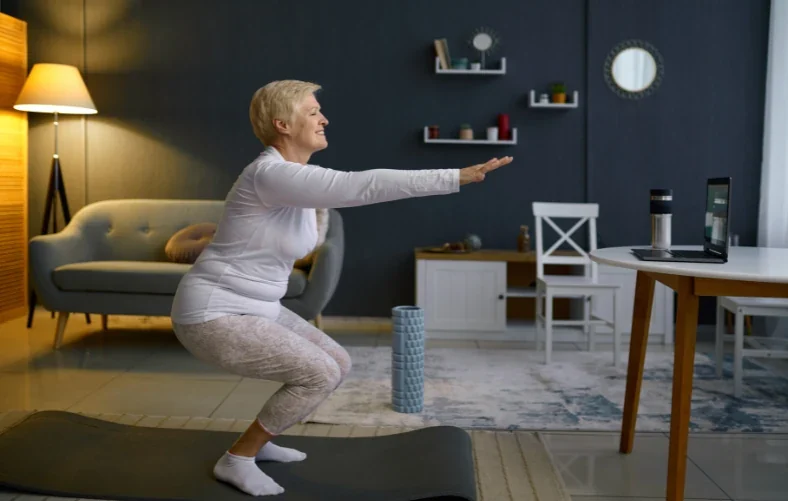
You may notice that squats and lunges are missing. Loaded squats and deep lunges ask a lot of your balance and joints, so this routine leaves them out. The gentle version, used in an NHS hospital leaflet, is a mini squat: hold the counter, bend your knees a little with your body upright and your heels down, hold for five seconds, then stand tall. Repeat five times.
How often, and how to progress
Aim for at least two days a week, and build towards three or more as you become steadier. Progress by using less hand support, then by adding a few repetitions, never by rushing. Add walking on most days, and consider a Tai Chi or gentle exercise class with a qualified instructor. A physiotherapist can set the right level for you.
Other things that matter as much as exercise
- Home hazards. The NHS advises clearing clutter, loose wires and loose rugs, using non-slip mats and fitting grab rails in the bathroom and handrails on steps. In many Indian homes, wet bathroom floors, long dupatta or saree ends and stairs without rails are other common trip points.
- Eyes and ears. Have regular eye tests and hearing checks, as ear problems can affect balance.
- Medicines. Ask a doctor or pharmacist to review them if you feel dizzy.
- Footwear. Choose shoes or sandals that fit, do not slip off and have a good grip.
When to get urgent help
Call 112, India's single emergency number, if you have chest pain, severe breathlessness, blacked out, or if you have fallen and have severe pain, a head injury, or cannot get up or put weight on a leg. Sudden weakness or numbness of the face, arm or leg, sudden confusion or trouble speaking are also emergencies. Do not wait to see if they pass.
Related guides: Five ways to avoid pain and injury when starting a new exercise routine, How to lose weight at home, 5 gentle desk-break exercises for back and neck aches at work.
Frequently asked questions
Is walking enough to improve balance?
Walking is good for your heart and legs, but the Cochrane review did not find enough evidence to judge walking programmes alone for preventing falls. Add the balance and strength moves above.
What else affects balance besides muscle strength?
Eyesight, hearing and some medicines can all affect balance. That is why the NHS advises regular eye tests, hearing checks and a medicines review as well as exercise.
Is Tai Chi worth trying?
The Cochrane review found Tai Chi may reduce falls, though the certainty of the evidence was low. A class with a qualified instructor is a reasonable option if you enjoy it.
Can I do these exercises if I have osteoporosis?
Balance and strength work is usually encouraged, but the safe version depends on your bones and past fractures. Ask your doctor or a physiotherapist before you begin.
What if I feel unsteady during a move?
Hold your support, make the move smaller (shorter steps, lower lifts) and rest. If you feel dizzy, sick or very tired, stop and wait for it to pass. If unsteadiness is new or getting worse, speak to a doctor.
Your next step: pick a spot in the kitchen with a sturdy counter, and do moves 1 and 2 three times this week. Strong bones help too, so see our guide to calcium and vitamin D in an Indian diet, and our post on desk-break exercises for back and neck aches.
Sources
- NHS, "Balance exercises". https://www.nhs.uk/live-well/exercise/balance-exercises/. Read on 13 October 2026.
- NHS, "Falls". https://www.nhs.uk/conditions/falls/. Read on 13 October 2026.
- Cochrane, "Exercise for preventing falls in older people living in the community" (review published 31 January 2019). https://www.cochrane.org/evidence/CD012424_exercise-preventing-falls-older-people-living-community. Read on 13 October 2026.
- World Health Organization, "WHO guidelines on physical activity and sedentary behaviour" (2020), as published in the British Journal of Sports Medicine. https://pmc.ncbi.nlm.nih.gov/articles/PMC7719906/. Read on 13 October 2026.
- Oxford University Hospitals NHS Foundation Trust, "Standing Exercise Programme, advice for out-patients" (October 2024). https://www.ouh.nhs.uk/media/kkpcxire/106311outpatients.pdf. Read on 13 October 2026.
- Ministry of Home Affairs, India, "Emergency Response Support System (ERSS)" (single emergency number 112). https://www.mha.gov.in/en/commoncontent/emergency-response-support-system-erss. Read on 13 October 2026.
This article is general information, not medical advice. Speak to a doctor or another qualified professional about your own health.
We may earn a commission if you buy through links on this page, at no extra cost to you. As an Amazon Associate I earn from qualifying purchases. How we earn